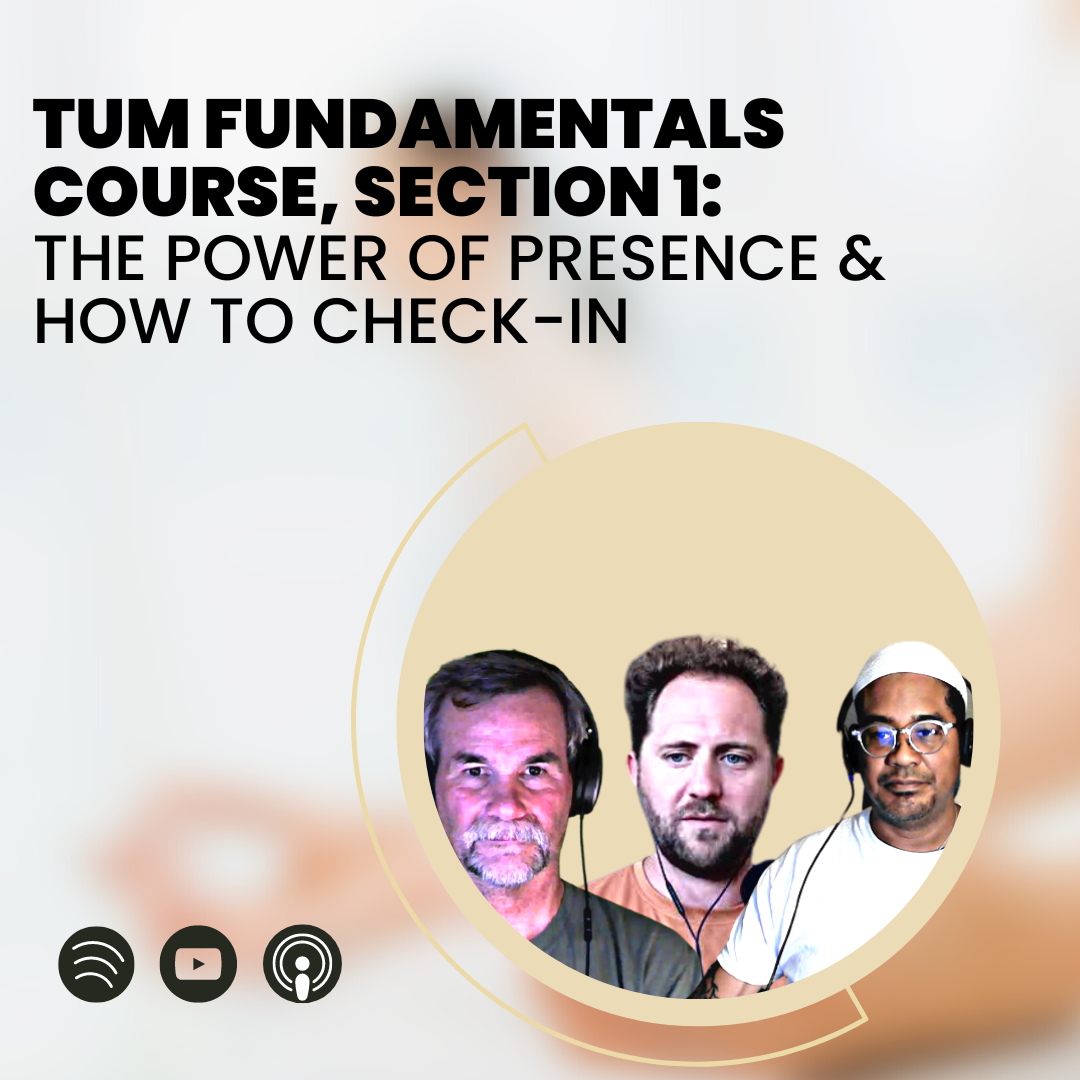
This episode is the first part of the Four (4) week Fundamentals Training: “The power of being present & how to check-in”. I’m joined again by The Unshakable Man Community stewards, Londell Jackson, and Mike Messersmith
In this episode, we will explore the somatic science of being present and why being present is a requirement to do the work that we do here in The Unshakable Man Community. At the end part of this episode, we will teach you how to do the 3×3 The Unshakable Man Check-in technique.
S2E9: TUM Fundamentals Course, Section 1 – The Power of Presence & How To Check-In
Show Notes:
- (03:18): Crafting the alliance
- (14:47): What is a brave space?
- (31:31): What does a man need to know to appreciate the power of being present?
- (35:16): What does it mean to get into the body?
- (38:48): Be prepared to feel
- (46:27): How to do The 3×3 Unshakable Man Check-In
Connect with Londell:
LinkedIn: https://www.linkedin.com/in/londelldjackson/
Connect with Mike:
LinkedIn: https://www.linkedin.com/in/michael-messersmith-8aa54814/
Transcript:
- Introduction
- Crafting the alliance
- What is a brave space?
- What does a man need to know to appreciate the power of being present?
- What does it mean to get into the body?
- Be prepared to feel
- How to do The 3×3 Unshakable Man Check-In
Introduction
Chris 00:00
Hey guys, welcome to the unshakeable man podcast a community for men who want to practice tools and skills to get out of our heads and echoic patterns and to get into our bodies. And this week’s episode, we begin the very first section of our four week Fundamentals course. I’m joined today with unshakeable man stewards, Michael Messersmith and Lawndale Jackson. And in today’s training, what we’re going to be doing is exploring some math, the science of the somatic science of being present, why being present is a requirement to do the work that we do here. And we’re going to spend the majority of the episode teaching you guys the three by three, unshakable man check in technique. So for men who have already enrolled in the training, and in the course itself, if you’re already a member of our community, all you need to do is go ahead and just let your steward know that you are participating in this month’s cohort. And then we’ll add you to the list so that we’re all engaged together. And we can communicate in the community. If you haven’t enrolled in our community, or not a member of the community and you’re listening to this on our podcasts. That is exactly why we publish these episodes in public, it’s so that there’s super accessible for any and all men to practice and to discover these tools and skills, you can absolutely practice this on your own. And you can listen to this episode. But we do need to be in relationship in order to actually practice these skills. And that’s why this community exist, is so that the men that are out there who want to practice tools and skills to get out of our head and egoic patterns, and to get into our bodies. Well, we have a community, we have a group of other men who want to prioritize this in their life, and in their relationships. And that’s why we’re here. So it’d be super awesome to see you in the community, just head over to unshakable man.com To enroll. And we start this course, every month, the first week of the month, and we move through it together. So Mike Mandel, welcome in.
Mike 02:13
Thanks for us. Nice to be here. Thanks.
Chris 02:14
Good to be with you, gentlemen. I noticed I noticed for myself a desire in every one of these just because we spend so much time together in group I noticed that desire to do the check in, in every single one of these episodes. But it’s funny because we’re, you know, we are talking about the work. And we are I’m showing up in a different way here, right, like presenting almost. And I noticed that tonality in my voice and the shift the subtle shifts on an in my body of how much different it is to be in group versus how it is to be here. But I guess I just wanted to share that because to me, sharing and talking about the work is not actually doing the work. And that’s, that’s a, it’s really important to me to always remind myself of that. And to remind any of the men who might be listening to this that, like when we’re talking about this out loud, or we’re reading about it in a book, we’re not actually doing it, right, that’s the view. And then we we have the practice.
Crafting the alliance
So before we just get us started here, I’d love to just start out with crafting the Alliance, and I’m gonna, I’m gonna use you, gentlemen to be able to do this authentically and to walk through this together as if we were in a group. But to anyone who’s listening to this out there in the future, crafting the alliance is something that we do in every single group. And it’s very, very important that we do this in order to allow the protective parts of ourselves that have come to form through an adaptive process of surviving to get to where we are today as human beings and men, that they can start to trust us to get comfortable to get uncomfortable, they can start to trust us to relax and to step aside so that we can do deeper work. And so crafting the Alliance. This is a set of agreements that all of the men in the space, we need to be able to agree to these in order to allow ourselves to show up and to create a brave space. And so the three things are confidentiality versus secrecy, the intention, which comes in three parts, my intention, your intention, and the intention of the specific container that we’re in that day. And then the third one is sometimes it’s called The Paradox of safe space or cultivating a brave space or brave relationship. And so my reason for for reviewing these with you hear today on the show and on the podcast is because you might be listening to this in your car. You might be listening to this while you’re getting some work done. You might be listening to This right before coming to your first group. And so it’s just really important to me that everything we talked about today be held within the context of crafting this alliance, right, because you can when you listen to what Mike and Mondale and I have to share here, this is how if we were in a space together in a men’s group, we would be doing this together, and it works psychosomatically the same way for you to listen to these right now and to agree to them, or if you don’t agree to them, to need to talk about it more to feel comfortable to get uncomfortable to do this work. Okay, so I’ll invite you, if you if there’s anything you need to talk about. With us. That’s why the stewards are here in our community, and to reach out to your community steward to have a conversation to be able to step into these containers. So number one, confidentiality versus secrecy. It’s just very important to me that anything and everything you share in these spaces is confidential. It is confidential, but it is not a secret. And so one of the reasons why we differentiate between confidentiality and secrecy is because sometimes when we form a confidential relationship, is what we do is we end up using that space or that relationship to escape our life. Okay, we create an island outside of our life that we can escape to. And then all of these tools start, we start using them to create a space that we can wall off and not feel uncomfortable, okay. But our intention here is actually to bring this work what we learned in this work outside of this space, into our life as it is. And so in order to be able to do that, in a group with a group of other human beings who identify as male and a group of men, right, is that we all need to know the difference between confidentiality and secrecy. And so what we do in these spaces is confidential. And what we share and say is confidential, but it’s not a secret, you have permission. And we actually want you to take this work outside of here and to share this experience with what you learn from this experience with your partner with your journal with your art project with your co workers, with your therapist, okay, or on your podcast, but you don’t have permission to talk about what another man says specifically in the group or to share personally identifiable information about another man. Okay, so does everyone here in the space understand that? Thank you on Dell, thank you, Mike. Okay, and so that’s how we start to get these agreements, okay. I noticed on an in my body when I shit when I saw them affirm that, that I felt a sensation of openness just immediately, and I already know these gentlemen. So the second one is the intention. Okay? And this is very, again, very important. This is the unshakeable man community intention. So notice how I speak for myself here. Okay? Notice how I speak for myself, I don’t speak for lundahl or Mike or you. Okay? So my intention is to create spaces where I can personally practice tools and skills to get out of my head and egoic patterns, and to get into my body. So my intention is to create spaces where I can personally practice tools and skills to get out of my head and echoic patterns and to get into my body. Now, Landau, and Mike, do you guys share that intention? Okay, so they both raise their hands. So now, if you listening to this, if you share that intention, and I share that intention, then what happens is, is we have now started to form a very special container. Okay. And the reason why this container is so special, is because the environment in our relationships outside of this space, by default, the default environment that we exist in outside of this space, we don’t have that intention. And the other human beings in our life, don’t always carry that intention, okay to slow down and practice tools and skills to get out of our head anechoic patterns and to get into our bodies. And this is one of the fundamental reasons why this work is so special is so sacred, and I’m going to use that word for the first time here sacred because of that shared intention, all right, to slow down and get into our bodies, okay? To practice those tools and skills and so this brings me to the third piece and the last one and this is As lots of different names out there, lots of different references to this. But my favorite two ways to call this or in our, in our community that they tend to get a gets called is the paradox of safe space, or cultivating a brave space. Okay. And so what happens is if Lawndale and Mike and I, were you listening, if we have an intention to create a safe space or the for the space to be safe, which we might or we likely have, if we said yes to that question is, is there’s a paradox to this. And that paradox is that, whether I’m conscious of it or not, I will very likely make the space unsafe from moment to moment, just purely because of some unconscious desire to have this space be safe. And this is why and this is what’s tricky about this is that if I want to have the space be safe. For Lyondell, I may manipulate or shift how I show up in order to try to make Lawndale feel more comfortable, or Mike may shift or change how he’s showing up in order to get me to like him, right. And this is something that simply happens through the divine through the development of relational intimacy, through through survival, right through the lot wanting to belong, it’s, it’s something that happens. But in order for us to be able to do this work to be able to work with any and all emotions in the space, what we have to do is just become conscious, bring this paradox to the surface, bring it out from the unknown area and bring it up into the light and just acknowledge that this happens in relationship, right, so that we can become aware of it. And then instead of cutting, instead of trying to manipulate or change or do something nifty to get around it, what we do is we make a different intention. And so we don’t have an intention. We don’t art we don’t want this space to necessarily be safe. That’s not my intention. My intention is to create a brave space. And that’s a space where everyone in this space knows how to reinstate safety when it’s lost. Okay, so we all know how to take responsibility to let the group know what we’re feeling when it shifts or changes so that if there is a rupture, or if I noticed myself disconnect, I’m not making it Mike’s responsibility to interpret how I’m feeling, I can take responsibility to let the others know in the group, how I’m feeling, okay. And in our community in our agreements, we simply ask that in order to do this work, if there’s ever a rupture in the group, you seem to be a part of the community, you agree to just return to the container. If a rupture should occur, in order to tended mend in order to move through, it doesn’t necessarily mean you’re going to end up liking that person or feeling connected to that person. But these are the agreements, this is crafting the alliance that allows us to step into this space, to start to work on and in our bodies, and to start to learn these somatic self leadership tools. So Londo, and Mike, that was a long description, but can you both take responsibility to the best of your ability to let us know how you feel? If you notice it should shift or change? Awesome. Thank you, gentlemen. Wow, I haven’t done that outside of a live group experience in a while. Did you guys have anything you wanted to add? Thank you so much for your patience and your body language and listening, it was really helpful for me, as I shared just that opening crafting the Alliance.
Mike 13:50
For me, I would like to share the very last creating a brave space over a safe space. That’s, for me, personally, that’s what allows me to really open up and really share deep, meaningful, vulnerable things. Because I know that it’s okay to share those things in this space. Whereas other groups I’ve been in where it’s, it has been a safe space. I was I was always cognizant of the people around me and ensuring that I was, for lack of a better term PC. It’s, this is one of those things that that makes this such a powerful expe rience
Chris 14:37
Londell, I saw you shaking your head up and down to you and jump in. Maybe we should we could actually just engage on this for a little bit because it seems it does feel I feel connected to this and it seems important.
What is a brave space?
Londell 14:47
DEIA diversity equity inclusion and access is what I do for a living. Thank you. And to that point. reason I bring it up is because as a matter of fact Hey, we just had this conversation in every workplace. And and, and unfortunately, in the process of getting moving people towards diversity, equity inclusion and accessibility, people feel as though in my experiences people feel as though they are not able to see what’s truly on their, in their heart without some sort of repercussions or retribution or some negative consequence coming to them. And, and to Mike’s point, a brave space is very different than the safe space. A safe space means to me, and to how I’ve observed it is I won’t be offended by anything. Anyone else says, no one else will say anything that will offend me. So therefore, it’s more of a, these are models where it’s obviously, it’s more of a kumbaya circle, that we’re all going to just hold hands and sing. And it’s not really addressing the issue. And that’s not what is not what DIA is, it’s definitely not what the NG command does. Change comes from being uncomfortable. And to be uncomfortable, you have to be brave. And so being in a brave space means being able to hear something, say something witnessed something that is uncomfortable. And when you are uncomfortable, you dive into that discomfort and understand why you’re uncomfortable doesn’t mean that you need to go into a story, a story or psychoanalyze, psychoanalyze yourself right then and there. However, it doesn’t mean that outside of that circle, or that moment, one does have to sit with themselves and say me, why is it that during this time, I have felt this way? Or why is it that this this triggered me?
Chris 17:00
Can I jump in with you? Yeah, go in here. Please do. So this and to the last episode, when we talked about the structure, right of the space. And I remember, I felt inspired and I and joyful, I laughed when you were like, oh, there’s no structure, right? It just in the setting that we were in in that space. What I would love to bring in is that this is one of the main reasons why I think that this type of community is so special and so unique in a man’s life is that this isn’t our office, this isn’t our work environment, we aren’t in each other’s social Mallu, direct social Mulu of connections. And so there is that construct or that ability to take a safe risk or to take risks in a way that might be very different in a dei e i, in process inside of my work right are inside of or even in another community. And at the same time, what I heard you say is like to understand why and and to notice things that make you feel uncomfortable. And what we’re doing here, what we’re going to do over this course, and over this program is carry men through the something to experience. And we’re talking about this before you go into the space, right. But what I want to point men to is what you naturally brought up in your explanation, which was something that makes you uncomfortable honoring your body. And so to connect that to the power of presence, and how to check in is that when we are in the groups, what we do is we arrive we have agreements, which are the just the beginning is that crafting the Alliance, right. And then we have our grounding. And then we have our first round check in our second round check in our checkout, and then our inspired integrations. And so the reason for this structure of allowing a man to check in and to share into the space is that when we slow it down, I can notice and when we point for you to notice what is happening on or in your body. Right? I can notice Wandel if you shared something. And while you’re sharing, I noticed that there is a sensation honoring my body that feels tight. Or maybe my shoulders come in, right. This is interoception This is body awareness, body fullness, right and this is what we’re doing in the groups, right? And then what am I feeling where do I feel it in my body? And then actually, we are not here to understand we’re here to sit with right and to watch the story in our head and I think that it’s that opportunity to slow it down. And to be with that experience, right, and I see you shaking your head up and down. So I’m super curious on Dell about what you’ll add in here, right? But it’s the oftentimes in in this work, it’s getting to watch the story in her head, go past, move through and be fully open to the experience on an in the body. And then also the sensations on an in the body that are becoming emotions that we have a feeling about that lead to a thought, and then a mood and a judgement and a story and a belief system. Right? They happen so quickly outside of the space, that if we can actually be in this container, and notice how I’m moving my body back and forth in like a wave motion, what we create is the opportunity to allow that belief system or that immediate reaction to fade, or we can actually be aware that it’s something we carry inside. And we’re not allowing emotional contagion or projection to project it onto you Londo. Right. And without honest, in this moment, I feel excited and and overjoyed that we were able to come to this, this space of an explanation of like, what happened in the group. Because the story in my head is, that’s what we were, that’s what we’re aiming for here is to almost like paint this, this picture. But even as I say that, I just want to say anyone who’s listening, that listening to this is not experiencing, right. So it’s very important to notice that if you feel inspired from this, come and try it out. I definitely jumped in there in the middle on Delta, if there’s anything you want to add, add to that.
Londell 21:51
No, no, no. I mean, it’s not that I don’t feel what you didn’t jump in the middle, you jumped in where you were where you needed to jump in. I feel as though I have to explain my added comments. I am an avid horror fan, horror movie fan, and so I can slate good things with horror movies. And so what I’m about to explain, you know, is not necessarily indicative of, of anything, really, but it’s just kind of how my brain works. So if and if any of you have either of you have seen the movie, get out to Jordan Peele movie, I can’t
Chris 22:26
believe we’re bringing get out into into our fundamental, our fundamentals course right now. But I do along the lines of D E. I, but I am ready, let’s, let’s do this.
Londell 22:38
Well, it’s just about the practice that one of the antagonists uses. And I want to liken it not pairing it I want to liken it to the chicken process. And and none of the words that that I that you use with vicforests When we first started working together was dropping in. And so in get out for those Mike, have you seen get out? I’m not okay. That’s fine. I mean, it’s more of a thriller than it is a horror but nonetheless. So this gentleman goes to his girlfriend’s house and, and some of the sundry things are happening. His girlfriend’s mother is a psychotherapist and she are hypnotherapist sorry. And the way in which she she hypnotizes people is with a tea cup, and she stirs the tea cup. And then she stirs the tea cup while she’s talking. She gets to a point where the, the person is so relaxed, and she takes her her spoon on the side of the teacup. And excuse me, and that the protagonist in this movie, he falls into what he calls the sunken place. Now, I know at this point, everyone’s like, Oh my God, that’s a horrible place that this man falls in. Well, what I’m liking it too is the depth in which we can fall into when we check in properly. In, in, in going into our feelings and dropping into that space because we I when I’ve dropped in, and when I do drop in. I drop in different levels. And sometimes I can drop into group at a level that is so serene and so deep. That it literally feels like there’s nothing else around me but the circle of men. Yeah. And so and it’s very intentional. And Chris mentioned this, this wave. He mentioned how he was undulating while I was talking and that’s very similar to the sunken place in which ironically enough Chris in the movie finds himself in a in a puddle in a pool of water. But it’s it’s the depth and you can go deep and you can come back and you can go deep and you can come back So, again, I’m not saying it’s a horrible, horrific mind controlling thing. That’s not my point at all. My point is taking the effort to relax and surrender, because the auntie or the protagonist in them in get out, did not believe he could be. He could hypnotize be hypnotized, do not believe he could fall into a space where he could just let go like that. And when he did, let go, he experienced, unfortunately for him some negative space. But fortunately for us, we can find some spot a positive space amongst the negativity, even if we have to release it. What happens or can so for me, that’s what I can.
Chris 25:44
And into that negative and positive space. What I would love to play in on this is, is that when we get into this space, and so this is the second stage of our lesson here tonight, and we’re gonna move into simply appreciating together out loud, we’re gonna move into simply appreciating what it means to be present, and how it’s connected to the body. Okay, and this is a key teaching for the unshakeable man community. And for you as a human being in your life, it making the journey to become whole, to be able to be fully expressed, as we call it here making the full somatic journey. Okay. And so, what I noticed in there Lawndale, is, you said, to make the effort to allow yourself to relax. And it’s almost like a paradox, right? Like making the effort to allow yourself to relax. And what I want to connect that to you here in our teaching is that we actually need a protocol, right? Lots of wisdom practices have these there’s many of them, and we teach them here, okay, and one of them is the three by three unshakable man check in, if you in our breathwork practices, we have 12 fold, lower belly breathing, we have wave breathing, but we’re going to learn tonight, the three stayed the three by three unshakable man check in as a tool set to get out of the head and into the body. And what we do is we learn the tool with our active awareness, and then we it becomes embodied and we get better and better at moving through it, and allowing our active awareness to relax, and to open, right and to allow sensations on and in the body to come up and out and for ourselves to drop in with a group of other men. Now, the other thing that we have helping us is we have community, we have co regulation, which is this thing that’s running underneath the surface, which is this concept of when, when two human bodies two, or three, or four, or five, or six, or 10, or 28, when we are in a space with the same intention to allow us with the having crafted the alliances, our nervous systems automatically start to sync up. And so when I witness Juan del moving through the stages of the check in and I start to blink, when he blinks, when I start to take in a deep breath, when he takes a deep breath, his his ability to get out of his head, and to get into his body helps my nervous system start to come in to rest and digest or tendon meant, right, and we start to get out of the fight or flight response out of our stress responses, and we start to discover that we can actually let go, we can simply allow ourselves to be. And then what I heard on Dell, again, what you brought in was this thing of getting to work with negative experiences versus positive experiences. And what we find inside the space is that there are no good or bad emotions. There’s only constructive or destructive reactions to emotions. And we go into this much more in depth in our facilitator training. And in our process groups. This is the introductory, this is the the fundamentals course. But we’re gonna mention this here is that outside of this space in the default world, There absolutely are good and bad emotions. We exist in this world where we cling to certain emotions thinking they’re good, and we run away from bad ones. But what that means on and in our body is that the nervous system shuts down to something that we consider to be negative, and we open up or we cling to things that we think to be positive. Okay, but that is a judgment of the quality of that experience on and in the body. Right? There are actually no good or bad emotions. There’s only constructive or destructive reactions. And so because of the space and the structure and the tools to check in that we’re learning here over this course, when a man brings something into the space, I notice a sensation on an in my body or an autonomic response that I can now become aware of, instead of shutting that response down, I can be invited to a Chris, what was that, right, and we can start to work with men in the space. But we’re not going to get into that in this Fundamentals course, that is something that the facilitators, and the men who are in the community start to learn. So that’s what you’ll learn as you move through your first 12 groups usually start to pick those skills up after about four to 12 groups, this fundamentals training is we’re specifically focusing on your first four experiences. And like we said before, once you finish going to your first four groups, you really could just leave this and have had this awesome experience. And I’m sure, my hope is that we’re going to hear from you in a year saying, hey, this was super, super helpful, it really planted the seed in my life, or you’re going to end up wanting to practice and to train together with us, as I have, as on Dell and Mike has, right. But you can certainly get a lot out of this by just going into these first four groups. So guys, how, what, you know it just creatively here, if I were to ask you just what.
What does a man need to know to appreciate the power of being present?
Chris 31:31
What do you think a man needs to know, to appreciate the power of being present? And connecting that to the body? Right? Like, what in your experience? Does that question Inspire? Or what do you think of man might need to know, just coming into here, and I can, I can rephrase it, what it means. So if to share what we’re appreciating what it means to be present, and how it’s connected to the body, from your experience.
Mike 32:05
I’ll speak for me. So for me, the day is the day is busy, there’s a lot of you know, activity with work and with family and you know, a lot of things that have your has your mind going and all this. And so I kind of look, look at this, coming into a group and, you know, the agreements and becoming present as a way to slow down, release all of that stuff, it reminds me of a commercial, I’m dating myself, but there was a commercial that used to say, Calgon take me away, and it was this person with like, a bubble bath. And they would just get in this bubble bath, and it would just, you know, totally relaxed them and, and all of the worries of the world going. But I think what this is, is this is actually, for me, it’s allowing me to get into a space where I can actually feel what’s going on in my body and not suppress it, not push it away, because I got to do something else. So I can’t be feeling that right now. Because because I’ve got this phone call, I gotta get into this meeting I gotta go to or whatever it is. Yes, totally. And so coming in here, and just allowing, slowing down, just allows me to get into my body and actually feel something. And that’s been a that’s been a fantastic experience for me.
Chris 33:36
to just juggle with you something I noticed in what you shared Mike, about whether it was great with the bubble bath is and with suppression, right with this, something I was wanting to share in there is that like this connotation that somehow like I shouldn’t be suppressing certain emotions. And even that isn’t bad or good. There’s constructive and destructive consequences for that suppression, outside of this space, right like to show up to be able to be an effective partner to be an effective teammate at your job. But what I notice in my language in your share is the the it’s almost like a portal. It’s like a like a mental, emotional, physical massage, of being when you check in and the group is it brings you into your body and you get to either allow these things to let go and you’re not holding on to them the way that you were before. But to me this is a practice this is this is literally like a portal in my life that I can see myself in, right like when I check in. It’s like this speed bump and then if Wandel brings something into the space or another man brings something in the space, even if I don’t fully identify with it in some way, or if I don’t feel completely connected to it. If even that gives me something to see myself or my own experience of my life through, which has a grounding, releasing aspect to it, and then I carry that awareness out into my life, right from the group itself.
What does it mean to get into the body?
Mike 35:16
It’s been kind of motion around in my, in my mind, since we’ve been talking about this. And one of the things for me, in coming into the group and then getting into my body, it’s when I start listening to other men, and there’s something that I react to. And so getting into that place where I can just, you know, be relaxed and feel that, and it’s like you said, Chris is not good or bad. It’s just what I do with that feeling. Am I going to be constructive with it? Or am I going to be destructive, but it’s mine, what it’s just somebody else has somebody else has has given that to you gift to me was through whatever their speak.
Chris 36:00
Your constructive or destructive response to an emotion just for you, just from your own perspective of that example.
Mike 36:08
Well, destructive for me, but just to be shut down. Because I want to be open to new experiences, I’m very much of a mind that those that we interact with are mirrors to us. So when somebody says something, they’re showing me something for myself. And so I can take that go, I can use it from a constructive perspective and go, Oh, that that person seemed really angry. What is that? What is that showing me? This this situation that they’re dealing with? Maybe I’ve dealt with that before? And how did that make me feel? Or I could take that and go, Oh, that’s BS, I’m gonna push that down and never think about it again. But I know that’s not the case, because I’m feeling it, feeling it in my body. So that means it’s there. So I want to do something with that.
Chris 36:58
Definitely, in looking to go deeper into this as we move through the training itself. But I think of something that’s important for me to share in here is that even in my asking you Mike, what is constructed or destructive to you, it’s really important to me that any man who’s coming in here, know that when I asked you that, it’s what’s important to me is that we, we discerned learn to discern for ourselves and be able to look at a constructive versus destructive response. We’re not judging. I’m not saying, Mike, that if you shut down to that, that that’s destructive, because from your perspective, that could have been a constructive outcome in that moment for you. Right, our construct of response, right. But as we learn to move into being in these experiences, together with this is how we together help men in the space to find their own wisdom and healing to be able to discern for myself on an in my body what, what is a constructive versus destructive response. And the way that we show another man versus tell another man what to do, is I share my experience of a relationship and just in the space. And maybe if that man is stuck in a destructive reaction pattern, he might feel inspired, because I’m inspiring that man, I’m calling him up. I’m not telling him what to do. I’m just sharing around him Londo, you’ve been so patient and just nodding, nodding over there. I’d love to just create some space for you. And guys, let me know if I’m not doing a good job of moving the energy around in the in the space.
Be prepared to feel
Londell 38:48
There’s no judgments to be had, sir. When there’s just so many things. I don’t feel like I need to necessarily add anything to the conversation. That I guess but I’m about to add something to the conversation, to be prepared to feel. I think that’s, I think that’s the key thing is for myself, I’m a pretty sensitive person. And I’ve always been a sensitive person. And I acknowledge that I’ve, I’ve often been very outward facing with those sensitivities, meaning it’s more about much more about being a victim. My life has been much more about being a victim of others. And I’m not going to minimize those feelings. And I’m going to acknowledge that I have learned that the feelings that I that I do have, oftentimes are mis directed at others when they are things that I really need to own and I’m resistant to owning them. And so to very much what Mike said, I’m become very judgmental of things. I see in others that I resented myself and so when either I have an issue with myself or with the world or another man brings up his issue. And then I become judgmental when he brings up his issue. I have to sit with myself and not I have to manage myself about again, why do I feel that? Why am I reacting this way to this man’s real lived experience? And that goes back to my feelings and feeling it and understanding where I feel it and there’s the stereotype of men not not feeling their feelings. I mean, we feel our feelings, but we may brush them aside or don’t some of us be brushed him, brush them aside, or some of us may not feel them feel we feel them, I’m just all differently.
Chris 40:45
Yeah, I don’t know what you’re feeling way to feel you don’t know what I’m feeling.
Londell 40:50
But the point I think I’m trying to make is just be open to feeling feelings, and be open to feeling them differently, and being open to new feelings. That if you come in now, now I’m being critical. And so this is my criticism. If you come into a space, being unwilling to learn like this, and in essence being closed, it’s not going, it’s not going to be helpful. Just because you’re, if I came into this space, thinking, I knew everything, this, you know, with my history, and what have you. And just, you know, said, screw everything, these, these guys just don’t know what they’re talking about, whatever, whatever. And was just resistance everything, then, of course, I’m not going to give me I pretend to check in and or even if I do check in and I’m resistant to what comes up for me during the processes, I’m doing myself a disservice. And I have to acknowledge that and I can’t blame or shift the responsibility to anyone else. So I guess my ultimate thing is to feel your feelings and own your feelings and be willing to process those.
Chris 42:09
Thank you Londell, thank you for bringing in like another another perspective into this when you when you when you shifted and said, like I’m being now I’m being critical, what I would love to do is use that as a as another lens into this space of one of the most beautiful and inspiring opportunities, I think and practicing and going through different experiences in these containers is the emptiness of the structure. And that if, because any and all emotions are allowed to be present, because we’re not here to get along. Because we’re not here to start a business to fix your relationship to achieve your goals to write, we’re literally here to learn how to be with to get out of our head and to get into our bodies and to learn to work with whatever is in the space. If a man is being disruptive, right, or a man is being argumentative, or is attacking another man, then that’s not in alignment with our agreements of just simply being able to do this work. But there’s something else that I think you bring up that is almost even more, which actually, to me always turns into what that man needed to learn. And oftentimes, we hear it later when the man reaches back out to us, which only develops more confidence in the work for me, and then I mean confidence in an internal sense of just knowing, like a knowing like this is it’s okay, right, which is that, oftentimes, we are unaware of our own protective masks that we wear. And the men in the space, our nervous systems can help you see yourself in ways that you’ve never been able to write. And so that might mean me being in a container with a man and then saying, Hey, Joe, when he said that, you tighten, you seem to tighten up. What’s going on for you right now in your body? I might protect that if I was Joe, and this is if Yeah, I might say, Oh, no, I’m not and deny. Right. But it’s, it’s through the being with in my experience. And again, this is why we’re recording this right, is that this community is a living breathing thing. This is not something that Mike and Mondale and myself can write down and then give you a textbook of map. This is a map, but you have to walk the territory and we are a part of this community. And we have to do our best every single day Every group that we show up into, to to open and to be with and to feel our way through this process as we grow. With that being said, I think we should probably transition on because this podcast is now We’re going to be an hour and a half long, and that’s fine. So we’re going to transition into the actual teaching the lesson here. And that is how to do the three by three unshakable man check in. Okay, so for this, I, what we’re going to do is I’m going to tell you what I’m going to do. And then I’m going to do it. And then I’m going to give an opportunity for Lawndale and Mike to go, and my invite to you listening, or moving through this is, while I’m doing this is I’ll just invite you to start to open and start to attune to even my own check in and lon Dells and mics. And if you want, you can pause the whatever the listening device that you’re on at the end, and you can do your own check in, in between maybe Lawndale. And, Mike, if you just want to give yourself the actual felt experience of giving yourself one check in before coming to a group. Okay, but if you have any questions, we have office hours every Thursday, and you can send them to us in the community. And we’re here to help. But along the way here, the point of this protocol is not to do it, right. The point of this protocol is to have a protocol to start to be able to become aware of our own awareness, right to start to see things in it every time we do it. And it’s a stairway to drop out of your head and to get into your body.
How to do The 3×3 Unshakable Man Check-In
Chris 46:27
Okay, so the way that it starts is I’ll say my name is Chris, and I am checking in. So you’re not gonna say my name is Chris, you’re gonna say my name is blank, and I am checking in. And I’m going to take a deep breath in my nose and out my mouth. Third thing I want to just add in here, there’s the structure, the language, and then the body. Okay, so the structure, the language and the body, we’re just going to go through the structure, the language and the body, I’m going to talk through it. And then I’m going to do it myself. So it starts out with my name is Chris and I am checking in, and then I’ll take a deep breath in my nose and out my mouth.
Chris 47:12
Now I’m gonna move through three stages of noticing. And at the end, I’m gonna say it one more time, my name is Chris, and I am checking in, I’ll take a deep breath in my nose and out my mouth. And then all that I ask is that the men in the space who are receiving me is that they acknowledge that they heard me, okay, and so just say something at the end, like Thank you, Chris, or good to be with you. Okay, now, in the beginning, after I say my name is Chris, and I’m checking in as men take my energy and awareness out into the space around me. And then notice three things on are in the space around me. And when I describe them to you, I’m going to use dry at descriptive language. And that’s important, I’ll tell you why in a little bit. Then I’ll take a deep breath in my nose out my mouth, I’m going to bring my awareness into my body. Okay, so I’m coming into my body, I’m going to zoom in, and we’re just going to notice three or more things on or in my body. Okay, sensations, honor in my body. Again, using dry it descriptive language, then take a deep breath in my nose, out my mouth. And I’m gonna scan my emotional state. And when I describe my emotional state, I’m just gonna give you three different ways that I’d like to describe my emotional state. And again, I use dry it descriptive language. And I always like to say you don’t have to be right, you can just be creative with this. Okay? So now along the way, noticing three things in the space around me, noticing three things honoring my body, and then describing my emotional state in three or more ways. I’m using dry at descriptive language. So the language that we use to relate to our experience, whether we’re in our head talking to ourselves, or whether I’m relating, or telling somebody about my experience, is what’s called formative language. Informative language comes in four major categories. Okay? We have amplification, suppression, judgment, and story. Okay, so when I’m describing my relationship with my experience of my life for my surroundings, I tend to amplify, suppress, judge or tell stories. And so while I am checking in or while another man in the space is checking in, the other men in the space are receiving me, okay, when I breathe, maybe they take a breath when I noticed something in my space, maybe they’d noticed something in their space or something not in their space. And what this does is it opens us to attunement, we start to attack whom to one another. Now, the next layer of this is giving and receiving powerful adjustments. And so the men in the space are going to receive your check in. And when we take receive you were listening for amplification, suppression judgment and stories are indulgent descriptions. And so what they’re going to do is, if I hear you or if they hear you use an amplifier suppressor judgment or story, I’m doing a lot of repetition here, then they may repeat what they hear you say out loud. And this repetition to you is an adjustment, it is not us telling you that you are wrong. It’s us pointing in helping you notice, hey, did you see that amplifier suppressor, that judgment or that story, and then you have a choice, okay, you have a choice to receive that adjustment, or to deny it, to throw it away, and not receive it, or to restate what you are holding what you are saying, okay, and when you do this, you actually connect to it more mindfully, more intentionally, on and in your body, because you’re being more emphatic with it. Or you can just repeat what you were saying without that. So this is probably better with a description. Okay. So imagine if I were checking in, I was noticing my space. And I noticed a really clean desk that I cleaned off this morning.
Chris 51:29
After a busy week in a camping trip, and my backpack for three weeks now from three different trips is still hanging off the side of it. Okay, I notice a really clean desk that I cleaned off this morning, and then I told you all this stuff about it. So really clean, really is an amplifier clean as a judgement of the quality of the desk. And then everything I said after that was this mindless, this, I wasn’t, I was up in my head telling you a story about all of the stuff in my head that is attached to that desk, and the blue backpack that’s hanging off the side of it. Okay, so if you are receiving me, men in a space, they might simply whisper to me, Hey, really clean. And then I can notice and just say I noticed the desk, where this becomes more and more powerful as as we get into our bodies. Because as we get into subtle sensations on and in the body, we have a tendency to suppress what we’re feeling on an inner body without even knowing it might be I feel kind of sad, I felt a little sad, versus simply just saying I feel sad. And allowing that sensation to come up on or in the body. And we’re here to support one another. And we’ll get into this later. But right now we’re just learning about formative language and to start to give and receive adjustments and to start to notice it in our check in. And so that’s why we do these check ins. Okay. So, here I go. I’m gonna notice I’m gonna take a deep breath in my nose out my mouth. And if you’re listening, now we’re actually moving into actively checking in. I’ll invite you to just follow along with my breath. If you want to take a deep breath in your nose, out your mouth, you could do it. Okay. So, my name is Chris and I’m checking in. Doing a full wave breath
Chris 53:41
I noticed two blue socks crumpled up on the floor. And notice the sound of a collar something jingling in the distance. I noticed a soft pink hue on the horizon. And the sound of somebody just started their car engine outside.
Chris 54:08
Physically honoring my body. I noticed tingly sensation down the right side of my ear lobe down the back of my neck. I noticed I just swallowed and stretch my shoulders. And I noticed my muscles in my eyes just relaxed, and I can feel my heart beating in the palms of my hands. emotionally. I feel joyful. I feel goofy. And I feel open. I’m Chris and I’m checking in. Thanks, Mike. Thanks, Allendale. I’ll pass it on to Lawndale
Londell 54:52
Thank you again Chris, this is Londell , checking in. In front of me, I see my webcam with a blue dot. I see a batik fabric hanging on the wall. I see under the man holding a sun salutation. Physically, I feel my left hand sitting on top of my right hand, which are both sitting on top of the desk. I feel my feet resting on the leg of the chair, and it feels more rumbling as my dog is scratching. Emotionally, I feel joyful. I feel a bit guilty. I feel in Brother, this is $1 to check in and to be with you. We’ll pass it over to Mike
Mike 56:04
I’m Mike, checking in. See a picture of Don Quixote behind Chris. I see a lampshade hanging from the ceiling. And I see a stack of business cards in my body, feel my toes crunched up in the skin with slippers. Feel the pressure from my headphones on my ears. Feel a pushing sensation on my right hip feeling tired and feeling open? Not feeling choice?
Chris 57:00
Could it be here with your mic? Checking in? Can we all just take a single super Breath? Breath like we just walked in the house we noticed someone was cooking. And then on our exhale, just go ahead and let’s just take that soup breath to start
Chris 57:24
What did you guys notice? Just getting to go from before to doing our check in to what did you notice in there check in that might be helpful to share your experience for any man that might be listening.
Londell 57:38
That’s why I prefer I like I enjoy the term dropping in. Because I feel as though we have dropped down level I can definitely I feel slower. I feel that our conversation slowed down I feel so much more intentional, right now. So we’ve gotten a level deeper than where we were.
Chris 58:02
I noticed the grin on my face to that
Mike 58:05
love that this sensation I get as I just doing that puts me in a space where I’m ready to receive. And so I love what Lawndale says about dropping in. Because it does it takes you it takes me from maybe being here. And then just slow down. Let’s get into this type of feeling.
Chris 58:28
I noticed something that I can really only laugh at. And it’s this realization that mondelli There were so many times in our our together today that I noticed you share there were probably four of them. That just came to me as I was witnessing you check in and my check in where I wanted to ask you Hey, Linda, what are you feeling right now? Where do you feel that and I stopped myself I held back from going asking you a question that would help maybe bring you in i and Mike deeper based on stuff things that you had shared. And Mike, I noticed a story in my head and a judgment that like I was like, oh, was I paying attention to Mike in the same way? Because because it was like what was more prevalent to me was like, a few moments where I actually like held myself back. But in this moment, I’m appreciating how that profundity right that like an ad to me it’s an it’s an awe inspires a like a there’s a tightness in my chest and a smile on my face like I can’t because it just aligns with all of these memories, these moments in my life where I didn’t make a choice to go deeper in order to be expedient, right or in order to do something to get something done or right and how just here today with you gentlemen, dropping in with you guys in a group as well. This is not a group right now. And I feel like protective of honoring that the group space where we’re not on video, right, but I have, we get I am appreciating how quickly I am able to actually be in a group with you man here right now, like I, I feel safe to do that. And getting to say a bit to you was just like.
Londell 1:00:27
I’m really really good at that.
Chris 1:00:29
But no, I, there are no right I don’t know if this is more advanced than we need to get, I don’t think anything that just automatically comes up in here is could be more advanced, but to men who might be listening to this, as you come into this community, it’s just so important to me to remind myself and any man who steps into this space, that there is we are not here to do this work, right, we are here to learn skills to be more open, to be to allow the fullness of who we are to come through. And to be able to experience our life more fully and to be whole. And to pass that on to art everyone and everything, right all of our relationships our work are calling. And it’s it’s just and so we have to discern it right, we have to feel it, feel through it and get to learn to use these tools in order to be in our experience, right and to learn to be more skillful to be able to pass to focus and to allow our to get into a state of flow in our life and just pass on where love really from my my words. So if you’re if I guess to finish this off, what I’d love to do is to just finish off with, you know, what, what do you guys, what do we want to remind men being in their first week, right? They just joined the community. After having listened to this whole thing, what do we what do we maybe want to leave them with, and I’m happy to go first to give you guys an opportunity to come up with something or to just scan your perceptual database, right? Anything that’s relevant, feels resonant, connected. But for for me, it’s I’m gonna I’m gonna go off of something that Lawndale inspired for me, which is to, to allow yourself to what I heard in my words from him was to allow yourself to get comfortable to get uncomfortable to try something new to have a beginner’s mind. And in that it’s really to just show up, right, even though you listen to this entire episode, to get here, and you heard three other men learn how to check in, please just wipe that out of your brain, don’t practice, don’t try to do too well at this. Right. The only reason for this to be here is to plant some seeds of inspiration and the hope that you pick this up enough to feel comfortable enough to come into the your first group. And that in that first group, if you want to check in, you get to check in, you’re always at choice to pass. But after you check in, the only thing you really have to do in your first group is just share what what in the world brought you here and have that experience. And then after the group ends, my invite to you is to reflect on that experience. And you can either reflect on that experience with a community steward one on one, a man in the in the group that you feel inspired to, to schedule a call with or you can reflect on it in writing in the community. And yeah, that’s my my tip here, pass it on to whoever feels like they’re ready to go.
Mike 1:03:41
I would say my my one tip is that you can’t get it wrong. Show up. Be authentic, be yourself, and you can’t get it wrong.
Londell 1:03:50
So what’s coming up for me? First of all, thank you, Mike. And thank you, Chris, both coming up. For me. I’m hoping this doesn’t sound way inappropriate. But I’m gonna say anyway, don’t be afraid to get naked, because it’s being naked amongst other men, particularly men that you don’t know, is really frightening. And it can be really intimidating. Because whether we want to admit it or not, we all compare ourselves to other what bits and pieces we compares different. Yet when we get down to it all. We’re all men all the same, regardless of shape, size, color, what have you and one we’re able to get past that. We are able to look at ourselves very differently. We’re able to be more appreciative of our own gifts and strengths. And we were able to love ourselves and I’m going to turn this on I statements I experienced physically being able to get naked around other men, because I have horrible body issues. I brace myself Stop judging myself, I definitely appreciate myself so much more, and compare myself a lot less to other men than I did before. And it’s all goes down to only the willingness about being vulnerable with other bits. And so that’s being willing to be naked in front of another meal, whether you know them or not, don’t assume that you know his intentions to assume that he has a motive, just be there. If you are to assume something, try your best to assume the best. And I know, when I don’t want anything, sometimes it can be difficult to have positive assumptions in the world in which we live, but we can have positive intentions if we so choose. And so that’s what I would like to share.
Chris 1:05:51
Thank you, Londell. So this is week, one of our fundamentals training, our invite to you is to listen to this full podcast episode, to give it a practice to give the three by three, check in a practice session, if you want prior to showing up in a group. And then your stretch is to show up in your first unshakable man checking group. And if you want to participate, to take, because you always have the ability to pass everybody has that choice in the group is to share, to practice doing your first check in and to share what in your life brought you to this space to this community, then to check out to have that experience and then to reflect on it either with your community steward, you can come to Thursday group session that we hold every Thursday and we record those if you can’t make it or you can schedule a one on one with a community steward or a member of the community who you feel connected to. Usually that’s a man that you’ve met in the group. And that’s where we start to generate that relational intimacy that brotherhood and that connection with other men in the space. Thank you so much Lonell and Mike. It’s just such a joy to be able to co create this fundamentals training with you. I will see you gentlemen soon for our second session. Survival, shame, the man box and belonging. Have a good night gentlemen.