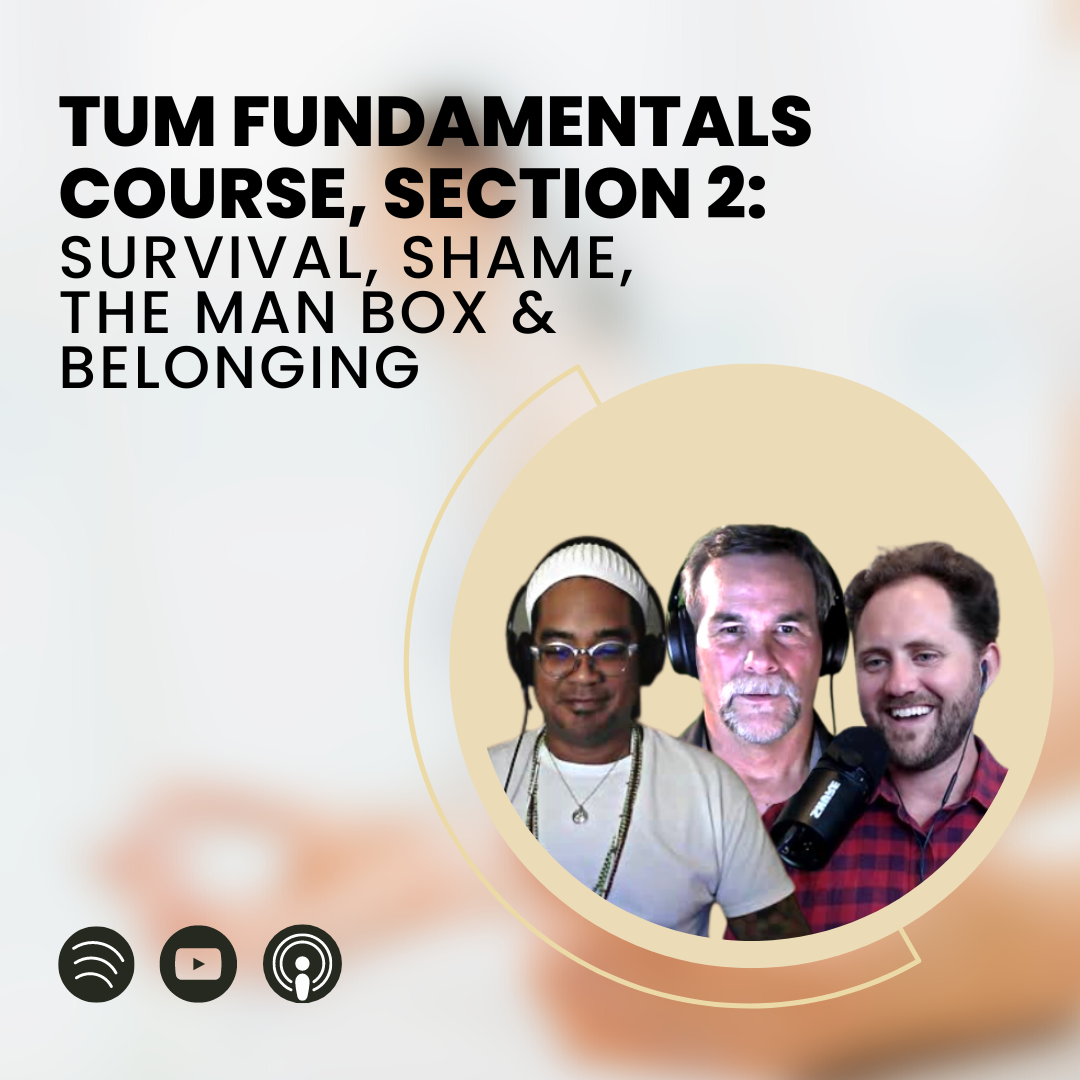
This episode is the second part of the Four (4) week Fundamentals Training: “Survival, The Manbox, Shame & Belonging”. I am once again joined by The Unshakable Man Community stewards, Londell Jackson, and Mike Messersmith
We will review the four concepts we use in our community – (Survival, Man Box, Shame, and Belonging) to connect and find a sense of shared meaning and belonging around our relationship with our culture of manhood.
S2E10: TUM Fundamentals Course, Section 2 – Survival, Shame, The Man Box & Belonging
Show Notes:
- (03:38): SURVIVAL – How men cultivate protective parts of self by surviving
- (05:45): The Myth of Monolithic Personality vs. Multiplicity of Self
- (06:44): Having the will to survive and what happens as we go through the adaptive process of survival
- (10:33): Why do we gather and train to get into the body?
- (11:55): What is emotion
- (13:24): What is shame?
- (15:13): Shame is the primary emotion that keeps men in the man box
- (16:18): What do you think of when you think of shame?
- (28:01): Exploring the man box
- (38:17): Acting tough vs. being the courageous primary caretaker
- (47:41): Belonging to a group of men
Connect with Londell:
LinkedIn: https://www.linkedin.com/in/londelldjackson/
Connect with Mike:
LinkedIn: https://www.linkedin.com/in/michael-messersmith-8aa54814/
Transcript:
Introduction
Chris 00:00
Hey guys, welcome to the unshakeable man, podcast and community, a community for men who want to practice tools and skills to get out of our heads and egoic patterns and to get into our bodies. My name is Chris Wilson, founder of the unshakable man community and I’m joined today with Juan del Jackson and Mike Mazur Smith. I’ll give the floor over to you on Londell.
Londell 00:22
Well, hello, everyone. Alafaya and it’s very nice to be with you all again.
Mike 00:28
Hey, everybody, looking forward to discussing Man Box. Really excited about.
Chris 00:33
Awesome, thank you so much for bringing that in, Mike. So guys, today we are in the second week, the second lesson of the unshakable man fundamentals, training, and course. And in this week, what we like to do is review, survival, the man box, shame, and belonging. These are four major concepts that we use within our community to connect and to find a sense of shared meaning and belonging around our relationship with our culture of manhood. And so to get started in this area today, I’d love to just talk first about survival. And can we bring in whoever has a cat into the space because Chesterfield is not here in the space right now. But now, so we’re gonna be talking today about survival, shame, the man box and belonging. Okay. And so I’ll invite you guys to join me in this, what we’re going to be doing is simply having a conversation about these four major concepts. And then we’re going to actually have do an exercise in this exercise is an exercise that we do in person, we’ve also done it in online workshops. And what we’re going to do is become aware of our own relationship, what is the man box that we exist in, in our subconscious, that we walk around in, in our own social milieu, that we get from our own culture, our own man, all the pets today, all the pets, so it’s survival, the man box shame and belonging on this subject of survival, we survived to get to where we are today, as human beings, and as men to be here to where you are listening to this podcast, I survived. Mondale, you survived, Mike, you survived, what happened along the path to surviving to get to where we are today.
Mike 02:41
I would take, I mean, to me, it’s in the DNA, you know, we as men have been, you know, the hunters, and, you know, the strong one, and, you know, protecting the tribe. And so there’s a lot of a lot of different things that I know, as we’ve talked about Memebox, some of this will come up, but there’s a lot of, you know, stoicism, a lot of strength, a lot of, you know, a lot of sweeping it within, to not show fear, and things like that. So those survival techniques aren’t what, for me, what has led me to where I am today, and now, being able to see that being able to change some of my patterns, you know, that’s so you know, there’s a, there’s a level of survival that, like I said, it’s in the DNA. But now, there’s a different type of survival coming into this.
SURVIVAL – How men cultivate protective parts of self by surviving
Chris 03:38
There’s a different type of survival. So for, for me, the the key here, in this shift that we’re looking for it as men come into this community is to just simply pause for a moment, and to recognize that that I survived, I went through things in my life. And along the way to get here, I reacted, I showed up in unconscious ways. I wasn’t aware of this. There’s an autonomic unconscious response that I went through when I was two years old. When I was the way I was nurtured by my mother and by my father, the way that I was supported by my social Mulu. The scaffolding in my life as a young man, as in as at 11 years old, at 16 years old at 2428. Right up until where I am today, I went through experiences, and along that, that path to doing that, I cultivated protective parts of myself in order to survive. For me, it’s creating an opportunity with men in this in our community, to recognize that these protective parts of myself that have formed through this adaptive process of becoming the man that I am Today, those protective parts I came to identify with them, they were so much a part of my personality, I might not even have been aware that there was another way of being right that there were other parts of me that were exiled or pushed down or, or just didn’t fit in to the way that I, I want it to be or could be in my relationships. And so, for me, it’s just having a conversation, whether we’re sitting around a set of couches, on a retreat weekend, whether we’re sitting around the room, and in one of our men’s groups, and it’s simply recognizing, as a group of human beings have been men that we survived.
The Myth of Monolithic Personality vs. Multiplicity of Self
Chris 05:45
To get here, there is a protective part of me, there are protective parts that have formed. And that’s not all of me. And we’re going to talk about that part, we’re going to talk about the myth of monolithic personality versus the multiplicity of self concept, right, that I am not just one way of being right oneself. I have many different ways of expressing myself, but just that simple concept that I survived to get to where I am today, and that I have a protective part of an external self, and I have an internal self, and that we are learning to allow that part to start to trust us or those parts to start to trust us to can set aside so that other parts of us can come to the surface and we can become more whole more, more open, more connected to our life. Landau, did you have an notice? You’re just so patiently nodding up and down. But did you have anything that you wanted to add to that just the survival topic?
Having the will to survive and what happens as we go through the adaptive process of survival
Londell 06:44
I do. I have to admit, I’m a bit hesitant as my dogs and cats fight around. Yes, I believe that inherently, the male sex has intrinsically over time, develop the skill to or desire to persevere and survive. And I am going to throw some cultural things in on top of that, you know, for me to be here where I am right now, it took literally a lot of blood, sweat, and tears for people to do stuff. And so there was, so it was also determination, sacrifice, and a lot of being pissed off. So and so when I think specifically with my life, and I think about the drama and the traumas, and the love and success that I’ve had, there have been times when I’ve thought about just ending my life. And the times when I’ve tried to end and there was still the opportunity or the desire, I would say not opportunity to survive, I can’t put my finger on what that or where that came from my mind did not want to be here. Because as far as I was concerned, there wasn’t a reason to be here. Yet, there was something inside of me that was compelling me that there was a greater purpose for me being here there was there was just more to what I was experiencing. Now, I’m not going to begin and go down some road of other stuff. But I will just say that there was something inside of me that was outside of me, ever that was beyond me, that motivated me and to survive.
Chris 08:36
Thank you. Thank you for sharing, Linda. So from from this place, it’s for me, it’s simply having this moment to appreciate that we survived, that we all went through something to survive to get here. And we’re not even, we only I only heard the word trauma in there once. And thank you for bringing that in on Dell. Right. But we’ve had, we’ve all had at least had some micro traumas, lowercase t traumas. And many of us have had capital T traumas. And I think the key here that we want to bring in as a, as a community and as a group of men, people who identify as male who exist within this culture of manhood and have is that is to recognize that throughout that process, we’ve cultivated this protective mask, and that in some ways, we’ve come to identify with that and say that this is who I am. I am this way, this type of person. But we’re not. We’re not nouns. I am not just a men’s coach. I am not just an athlete, from when I was 18. I wasn’t just software sales guy. I wasn’t just a son. Like I am a verb. I have ways of expressing myself and we’re all verbs then I’d love to Jump to is shame. And so along the way, what what is what are emotions and at this stage of stepping into the unshakable man, it’s very, very important that we have a working definition of what an emotion is. And I know that we, we’re now stepping in for anyone who’s listening, we’re stepping into the second concept that we’re talking about here, which is shame. And we’re using shame as to explore what is an emotion at the beginning of this show.
Why do we gather and train to get into the body?
Chris 10:33
Every week, we say, we are a community of men who want to practice tools and skills to get out of our head and egoic patterns into get into our bodies. And I always get this moment, whatever I say that of wanting to just pause and be like, Why? Why? Why do we want? Why do we as a community of men? Why does Lawndale and Mike and myself, why do we show up with this shared intention to want to practice tools and skills to get out of our head, negotiate patterns, and to get into our bodies? And for many men who come into our community, when I asked them, Do you know what an emotion is? Or do you have a working definition for your own practice of just what is an emotion, many men do not, they don’t have a working definition of what an emotion is. And so this is where there’s just this incredible learning moment to just notice that there is no current definition of what an emotion is, we don’t have emotions, researchers do not yet agree on what an emotion is. And so and the reason for that is because we don’t have a way to measure or to track where I’m at, and the motion came from, we don’t know exactly what its source is, okay.
What is emotion?
Chris 11:55
But the definition that we use here in our community, in order to do this work together, as human beings in order to relate, is we use the definition in motion from Dr. Eve, Ackman and her work with the Dalai Lama, and the atlas of emotions, and it was just on what do emotions researchers agree on. And so the definition that we use is that an emotion is a physical sensation that’s happening in our on the body, that the mind, and I love to use my body language when I do this, that the mind the mind is not in your brain, it’s anywhere your awarenesses, right, so the mind is consciously or subconsciously aware of meaning, you might not be aware of it, right? That is sending a message to the brain, that something important is happening to the body’s well being. So an emotion is a physical sensation that’s happening on or in the body that the mind is consciously or subconsciously aware of, that is sending a message to the brain that something important is happening to the body’s well being, and what later, I want to make a connection between the culture of manhood in what the man box tells men we need to do in order to be a man in order to be in the box. But I just want to put a pin in that for Mike and Mondale and myself to make sure that we come back to that, to make that point in here to make that connection for all the men who are listening to this.
What is shame?
Chris 13:24
And so what is shame, right, if shame and in just a moment to to bring you guys in, I am going to ask you as what is your relationship with shame? How have you noticed shame cannot be expressed through your life experience. But what is shame and so shame, our working definition of shame is that shame is about belonging. Shame is about belonging. Shame is the emotion that says if I said what happened, if I shared what is on the inside, I would not be allowed in the tribe. I need to be ashamed of this. If I shared this with Wandel, or with Mike or whoever I’m in the tribe with I would be pushed out of the tribe and therefore I feel ashamed I feel and guilt is acknowledging that it’s presencing it and so to process shame, we have to flip it into guilt we have to acknowledge we are ashamed of and bring it up into the light and be guilty. And humans love to accept guilt. And one of the main root reasons why we we feel that we feel that connection is because we all can deeply appreciate that when we notice when we witness another human being. Take what from what is unsaid, give voice to the place inside that didn’t have a voice and to acknowledge shame in front of us, we can appreciate how powerful that is how scary that is how big of a risk that is, and receive it.
Shame is the primary emotion that keeps men in the man box
Chris 15:13
And shame is the primary emotion that holds us inside that maintains the glue of the man box, what we’re going to talk about next in here, the man box. But before we move into constructing the man box and deconstructing the man box, and let me say, while I mentioned the man box, we do we are not saying that the man box is bad. We’re not saying that it is bad to be the man box to be the definition of what it is inside the man box. But we are saying is that it is cathartic. And it can be a cathartic release. And we can be more whole, we can be more flexible. When we dismantle the man box when we’re not controlled by it, and pushed inside of it, or outside of it and shunned away from it. A lot of talking for me just now. So I’d love to just bring in what, what is what comes up for you guys, when you hear shame, when you hear me even engage on the topic of shame.
What do you think of when you think of shame?
Mike 16:18
So this is gonna sound funny, but you know, one Dell brought in, get out in one of our one of our episodes. So for me, when I think of shame, I think of Game of Thrones. And there was a scene for anybody that’s never watched Game of Thrones, where somebody has been stripped naked, and then walk through the city, while somebody is behind them yelling Shame, shame, the entire way. Because she had done something shameful for me was shame is something that I work with, often because it’s something that continually comes up. So when in relationships, oftentimes, people not realizing that, that they mentioned something you did or didn’t do, or whatever it is, and what was that shaming that goes along with it. And so you’re continually working with that room, looking for ways to come out of that, for me, it’s something that I’m very well. And something that consistently talking to myself about and they don’t know.
Chris 17:29
You know, Mike wouldn’t as you shared, you brought in like Game of Thrones, I, you know, there’s something important for me to share in here, which is that we all we all deserve our hidden gardens, I want to make sure that any man that’s listening to this, you you do not have to express what you are ashamed of, or it you’re even have shame. You are the only person who knows what you are feeling can report on your experience. So I just want to make sure I noticed a protective part of me come in and want to make sure that Just the mention as we talk about our relationship with shame that I don’t send a message here that any one here needs to be shamed, right or needs to feel ashamed of how they’re they’re feeling, especially manufactured shame, right from our culture from ourselves shaming ourselves. But for me, the the memory that came in about my relationship with shame is that I noticed that for me, shame is is beautiful in my early 20s I really had like a judgmental perspective on what shame was when anybody would even mention feeling ashamed. I would feel tight, maybe and, and why are you Why What are you going to be ashamed of don’t be ashamed, as if, as if it’s just like something to not do like, like, don’t, don’t be ashamed just just be you. That’s like, just put on a show, put your chest out like I just did this just don’t be it. But yet within the context of my opening experience, through through setting with other men, through being in these in these spaces, which are confidential, where we can stay the unset and we can check in and we can take bigger and bigger risks to give a voice to these places inside. What I’ve noticed is that learning to to, to to take ownership of what I am ashamed of and to even recognize that there is like a sense of shame on this edge deep down inside, or to see it through another man’s share and to realize that I’m carrying that and I didn’t even know it has been a beautiful opening experience without I would feel lighter from and feel connected to men in a way that I think Wandel you talked about where I feel like from the outside from a judgmental person If I, I wouldn’t think the way I look with another man, that I share anything, but then realizing that when a man takes a risk to, to share with something that he’s ashamed of, and then I realized, Wait, I didn’t even know I had that I noticed this place inside. And that, to me is one of the ways that from a co regulation perspective, being in a group really helps you to do your work. Because when men take this risk, it helped me find places inside that I hadn’t yet uncovered. Right. And so it’s, it’s beautiful, to me, it’s this blossoming, and getting to honor it and bring it up into the light and then change my behavior in some way or make a shift in some way. The other thing that I noticed is this memory that came in just now where we were at a party where my partner and I fiance, Anna, and I were at a party. And she told me that the way that I was being in the presence of of people that we didn’t know that she felt ashamed of the way that I made fun of myself, in a in this party, when I was having an interaction with a group of other people, and that she didn’t like the way that I was being when I was with them. And I noticed that when she shared that with me, my whole I turned red. And there was this urge to deny it, or to say that, Oh, that’s not how I was being. But then that turned into this awesome opportunity within a group to really realize like, Wow, is that how I’m being? Can I see that in myself, this tendency to be away that my partner doesn’t, right. And in a way, it was like, it was this awesome way of getting to realize that I could deny this, I could project a way and tell a story about it. But by being in a group, with a group of other men and checking in on it, really realized, like she was helping me see that this is something that I don’t, I don’t really like about a protective part about the way that I show up, or I used to show up, and that that was coming out in this setting. And it felt really like a big deal to me at that time. So seeing that through my partner.
Londell 22:20
I can definitely understand and relate to that. I probably won’t list all of the reasons why I find shame in my life. But up until I think, maybe three years ago, it wasn’t until I was in a coaching call a group coaching call that I realized that I had been living my life in shamed, it was shame for so many reasons, and things that I have not forgiven myself for projections of our national community, ethnic and racial communities, and so on and so forth. And it led to it as it has led to my persistent othering of myself, in almost every situation, I find myself and so now that I know it, and I revise it, it’s now just an everyday activity of mine to not be not feel guilt related to the shame, being embarrassed of the shame related to the guilt. And then loving myself through it all in it 49 years old, it kind of is, it becomes really difficult because I’ve almost hardwired into myself that I am all of those things to be shameful, ashamed of. And so and then when I think about these things in the man box that I’ve tried so desperately to live up to, then I feel shame about that.
Chris 23:56
What’s the smile the laughter?
Londell 24:01
It’s a paradox. It’s for me, it’s a paradox. It is that I recognize I recognize, I recognize the again not saying that the man box is a bad thing in my life. I have stripped I have strived to meet those qualifications that I have seen within the man box. I could never achieve and I was ashamed of that. And and now that I have the power and the will to reject the ban box, and many of the things within the man box
Chris 24:40
What about to remake it feels I feel scared to reframe you right there.
Londell 24:47
You can reframe and I guess yes you can reframe and the reason I’m a bit resistant is because I don’t want to be in a box at all. I just want to be myself celebrating that I love that. And so yeah, so so there’s that. And, and, and so I want to refute that, and, and just be myself. Because whenever I try to put something in that, in a space, a confined space, it is confined and there are limits within that space. And if something goes in, something has to come out. And so I just want to be. And that’s what I’ve learned. And that’s what I’m learning to accept them. And so that’s why I smile and laugh, because it’s that paradox. It goes back and forth, and back and forth.
Chris 25:37
Thank you Lawndale thank you for for bringing it into this space and sharing your relationship with that. And in a way, for me being just a shining example of what we are doing, at the intention for this space and for the community in our are being here. Right? I am that the word paradox, right? For me, it’s this paradox to manage, not a problem to solve, and noticing and creating an opportunity for the three of us to engage on this, but then for other men to hear this, and that it’s not the whole point of this, of this exercise of this, this stage, in our journey from joining the human community, to belonging within the chicken line community is to create the opportunity for us all to notice, and, and, and release or just be with our relationship with this thing called this man box, right and to see myself through you and for you to see yourself through me, and to realize that we all have this ability, right to do this. But while saying that, recognizing that there are literally human beings and men just outside of this space, and all of our homes where we live, that exists just down the street, right across the street, in our own families, that have not had the physical opportunity to be in a group of other human beings who identify as male, and to feel the sensations in and on their body. And to allow that shame to be expressed. And to bring back in what an emotion is, right? Like, I really want to make this point that an emotion is sending a message to your brain, that something important is happening to your body’s well being that in some way. If I if I talked about this, if I express this, I’m not going to be allowed to be here. Yeah. And that. That’s what we’re cutting through. I felt a shiver like down my ears. And so survival
Londell 27:57
I call it a polygon
Exploring the man box
Chris 28:01
Polygon, let’s just make it a circle. All right. So, so we have survival, we develop this protective mask, become aware of this, we realize that it’s there, we have this external self and this internal self, and there’s, there’s a delta, there’s a difference, then we have shame that we’re working with. And rather than trying to run away with it, we’re using it as a tool to connect, and now we have the man box.
And for the man box, I want to bring in this concept. And I want to be very specific here about the difference between the culture of manhood that we exist in. Okay, this is not your masculinity, this is not your expression of your masculinity, or your femininity, which we all have. And in many ways, we are creating a space for us to be able to openly express and to be able to fully wield our masculine and feminine gifts, right as people who want and identify as men, okay? But we exist in a culture of manhood and there is what’s called a hegemonic culture of manhood, which is the culture of manhood, that is, in power or is in control, or the predominant culture of manhood, within whatever social Mulu we exist in, right, whatever when we’re looking at so for example, we could have a hegemonic culture of manhood in San Francisco, or in the Castro, which might be very different than the hegemonic culture of manhood and Boston that I grew up in, right. But today with the with globalization and social media and our interconnectedness, and all of these apps, sending us messages on our phones with Disney, right with books with stories With with our family lineages, right? Our ancestral lineages with the archetypes of what it means to be a man. What I’m attempting to do here is to conjure just how massive this thing is right in our life, that we exist within this, this culture of what it means to be a man. And so one of one of our my favorite exercises, and what’s really neat that I just want to call out is that we’re not faking it here, right, like, Mike Wandel. And myself, we are going to do this exercise. And we I have done this exercise many times. And every time I do this exercise, I think part of it that makes it even more powerful for me is that it’s easy for me to think that because I do this work, somehow I’m outside of this box now, or I’m not, I’ve done it, I’ve worked through all these issues with manhood. And it’s just simply not true. It’s just not true every time I get to experience this with another group, a group of human beings who identify as male, I get to re discover that this like, Ah, this like awareness of this awareness of what is what’s here, what are we working with. And so the exercise is to simply make a list of 10 words 10 phrases, 10 traits, 10 things that mean to be a man, the invite is also that you don’t have to agree with these. And if you can do more than 10, please do it. And so what we’re going to do is we’re going to make our lists right now, we didn’t prepare this. So Lawndale, and Mike and myself are each going to make a list. And then you as a listener, is the man in the unshakeable man community. If you’re in the second week, your stretch is to make a list, make a list of your 10 words. And so I’m going to do mine right now. And so I’d invite you to pause this so that you don’t get affected by us so that you can see how similar or dissimilar, your sandboxes I went quiet while I make my list.
Chris 32:19
And then to Lawndale and Mike, I would love it if you would do the inverse of what it means to be a man. Now after you get to 10 what it means to be a man now.
Chris 32:39
And then, just to prepare us so we don’t have to pause later to make a list of what the culture has said to you if you weren’t these things if you weren’t what is in the box. So we have 10. In the box, we have a few for what it means now, as an integrated, unshakeable man, man who has done some work to allow his protective parts to trust him to become fully whole, open. And then some words that have set been said used by the culture to threaten you to stay in the box. All right, give you guys a 15 second.
Chris 33:40
So our next step here is to just go around and have to just go we’ll go lundahl Mike, Chris Landau and Mike Chris. And we’re just going to share what one word at a time what are the words that construct are inside the box the words or concepts? Whenever you’re ready, just give one at a time and we’ll go around briskly. Bearded, going, tough,
Londell 34:07
muscular.
Chris 34:09
Provider.
Londell 34:10
financially secure,
Mike 34:12
Suffer in silence,
Chris 34:14
Athletic
Londell 34:15
Deep and powerful voice.
Mike 34:18
Don’t play with dolls.
Chris 34:20
Penis size
Londell 34:21
Sexually promiscuous.
Mike 34:23
We don’t shorts.
Chris 34:25
Aggressive
Londell 34:26
Sports loving.
Mike 34:27
Don’t cry
Chris 34:28
Forceful
Londell 34:29
and emotional rock
Mike 34:31
Protector.
Chris 34:33
Hunter
Londell 34:34
Inexcusably male
Mike 34:36
Leader
Chris 34:37
Loud,
Londell 34:38
Heterosexual
Mike 34:40
Good at sports
Chris 34:44
What kept us in the box. What did we hear? What did we see? What messages did we receive?
Londell 34:52
You’re weak. You’re gay, and you’re stupid.
Chris 34:55
See if we can go around again, one at a time. Things that were used To keep us in the box things that we might have heard or said, or threatened
Mike 35:04
Some of the things that I said are those things that kicked me in the box. Like don’t play with those.
Chris 35:11
Weird. Don’t be weird for me. Don’t be a girl to be a fag. Mama’s boy, wimp. Get a job. Fishy. What are you doing?
Mike 35:22
Suck it up, buttercup, man up.
Chris 35:26
So what are you guys feeling in your bodies right now, as we conjure this?
Londell 35:30
I feel anger, and I feel shame.
Chris 35:33
Where do you feel that in your body? If you’re okay to go into that under
Londell 35:37
my throat of all places? Just it’s, it’s in my chest, but I’m feeling it really in my throat? It’s like I’m choking on
Chris 35:45
it. Is it saying anything to you?
Londell 35:49
It’s saying I don’t have to hold on to it. I think that’s why it’s in my throat, I just need to throw it up. It’s just acid, bile that just needs to be purged from my wife
Chris 36:00
Feel energized, as you said that I noticed for me that just as we went around, I noticed tightness in my throat, a de energizing quality to this whole thing. And a story in my head of I don’t fucking agree with this.
Mike 36:16
Yeah, it’s weird. Going through some of those, some of the words that we said, you know, resonate. And some of the things, some of the things, it’s not good or bad, but some of it really, I had a visceral feeling to some of those. I mean, some of the things that you both said, I had a visceral feeling but But what I find interesting is I have this, it’s this weird sensation, it goes down both of my sides. And it’s almost like it’s energy coming out. When I felt something or heard something that I didn’t agree with, I actually deal with that actually feel it breaking out.
Chris 37:03
And what about for you? Are there any in there that you felt like you felt connected to? Or felt like you you couldn’t had a difficult love hate relationship with them?
Londell 37:19
Although the ones that that are in the ones that he played in the box are the ones that keep people in the box or all the love? I have a love hate relationship with the whole bearded, muscular, financially secure thing in our society right now. It is the thing to have facial hair. And and it’s been that way for I don’t know, like 1010 years plus, at least. And I know in the gay community, it’s just like you are, it’s a coveted asset. I just don’t have the genetics to do it. So there’s a bit of, there’s a bit of self loathing that goes along with that.
Chris 38:07
Is there an attraction to it?
Londell 38:09
Oh, totally. I mean, I love it. I mean, yeah, I love it. And I hate it. Yeah, it’s a jealousy envy
Acting tough vs. being the courageous primary caretaker for my parts
Chris 38:17
But, but I appreciate you having the courage to bring that to bring that in here. Mike, I noticed that you brought in this concept of that there’s parts of this that you can’t quite disregard like it, we can’t throw this out. Right. And I think that that is for me, provider, as a young man growing up in a family run Bed and Breakfast, my father and being around this place that I could always return to no matter what was happening in my life with my mother with work outside having a place that I could be right and that that it wasn’t necessarily about like money, it was about a safe space, being able to provide that, but yet, in my head.
As an adult man, this concept of like that I that there’s like this culture of like, I am the breadwinner, and somehow my partner my fiancee is not doesn’t have her own career and, and interests and things that she wants to do with her own creativity. That just does not. That does, does not mesh, right. It doesn’t match. But then at the same time as I’ve moved through my own entrepreneurial journey and my own leaving of a stability of a job job and made charted my own course out into the work that I’m doing here and what I do with night, my life today, there is this ability to own I ship to be able to take responsibility for my own parts of myself to be able to be the primary caretaker for those parts. In on the outside, it’s as if there’s this image of being a stoic man. But now I have a community of other men that I can go to, instead of going to my partner, I don’t need to bring to wine entirely rely on her as my emotional place to go, I can learn to bring these things to other men and where I can take responsibility for them and put them at put what’s into the space there and be met, as I am guided to find my own wisdom to find my own direction and to pick myself up. And it’s so wild to me how this like this, like, it’s almost like we go i, for me, my my felt experiences, I go into these spaces to be patient and caring, and compassionate, and powerful and tender, and focused, and loving, and to dance with you guys. And to be this warrior of love within this space, which is outside, right, which is inside the unshakable man commune which is inside my group of friends that I hang out with every day, but then it allows me to actually almost embody this, like, what I noticed more and more in my, in my sense of how I show up as how I’m expressing myself, I feel like in a way, like I, someone could look at me and almost judge me as that, that 50s Man that like breadwinner, right, and that just doesn’t compute, there’s this mess up here, right? Like, I do want to provide, I do want to be able to create a space where my partner can feel safe to follow her own creativity, and to quit her job, I want to be able to do those things. But it’s, it’s come at the after the five year journey of deconstructing my relationship with this box, right, and being in community, with men who are human beings who identify as male, but they’re in their way. And we’re not even and I do want to just point out that there is one major topic in here that we are not getting into, that we will get into in this in the future. And that is human beings who don’t identify as male who identify as non binary, or are transgender. But you exist and you choose to be in this type of community, right to be in a community. And notice how I keep saying identify as male, right, because that I do think we are getting into a territory here where we have to start being able to recognize this identification, right? That that is a choice, right? Like the men in this community. I’m not checking, right, I’m not checking, it’s what you self identify as, which isn’t true for all Ben’s work organizations. Right for that. That is not, we can’t say that for the manosphere.
Londell 43:16
I would take that even further, you know that there I’ve experienced, I’ve experienced as I was searching for men’s groups that there, there are some men groups, men’s groups that are very specific about how they define a man it is had definitely heterosexual, oftentimes Christian and more oftentimes, a white male, it’s those very those three components, and they won’t, they will not outwardly say to you, that you’re not welcome. But however, when you engage with individuals, when you read their documents and their website, and what have you, it’s just blatantly obvious. So there’s that too. And that’s part of the box can be part of the box.
Chris 44:04
And it’s, and I appreciate you bringing it in here because it is it is we are working with this in our experience of our lives, right and I as a group of stewards of this community, and knowing that the men who want to participate who may be coming in to move through this experience of this Fundamentals course, that it is important to me to to take responsibility as as one of the men who in a leader here that I feel a sense of dis ease a sense of fear, and an appreciation for like I am, I’m white, right? And I have things that I am unaware of that I like just from my own unconscious scripting, right. And at the same time, I can want to make this work except possible, and at the same time as wanting to make it accessible and wanting to make it sustainable, right, and recognize that it is an actual challenge to be able to be diverse for our community, right to welcome that diversity and to actually have the resources and the the knowledge and the understanding, to be able to welcome that diversity. But I think the first step for me and here is just acknowledging that right like just being like, I don’t know, doing the best that I can, and I’m willing to, to learn. Here we are, we’ve talked about survival, developing development of our, the adaptive process of developing our protective parts that we come to identify with, to say, I am this guy. For me, as a young man, when I was 22, I was an aggressive, goal oriented, athletic, I want to make the US National Team and cycling, I want to achieve these goals. That is who I thought I was right. And yet underneath, I was so much more. Right. And for many men coming into this work, learning how to build a relationship with that mask. So then we have survival, and then shame, the emotion that says if I shared this, I wouldn’t belong now we’re conjuring developing, bringing up painting a picture of what this man box is how we’re you, we’re shamed. And the emotion of shame is the primary driver, or the threat of violence of if you don’t earn your manhood, if you don’t step up and become a man and man up and hold on to this box somehow, just by default, you just fall out of the sandbox. And that somehow means you’re are shamed you are you don’t belong in here, the whole reason why contextually we do this somatically why we are using this in our fundamental in our fundamentals training, is because of this paradox, because of what you said Lawndale that this is a paradox to manage, not a problem to solve, right? Like we could make our whole life around denying this man box and in a way change how we dress change how we look, try to pretend that it doesn’t exist. But instead, what we do is we actually recognize that this is a paradox to manage, not a problem to solve, and let’s bring it into the light and use it as a way to actually have a felt experience of belonging. Right.
Belonging to a group of men
Chris 47:41
And that’s where I want to just transition to this last piece. which is when you when a human being when a man enters into a community, with a group of other men who he judges from the outside to be stable, they can take responsible, you can take care of yourself, meaning you feel open and connected and trusting around them. And then we have this experience of being able to actually open this box up and to start to dismantle it and not throw it out. We get to a felt sense of belonging, right. Like even though on Dell, you don’t look like me, I feel connected to you. So if we could end on that, like what has your guys What have your relationship been with this whole process, right, whether it’s tonight, or in the community. And then what we’re going to do is and on our what we’re directing men who are listening to this, who are in their second week, you’re coming to your second group, we’re going to end on a strong focused intention for what we want them to do in the community, knowing that they’re at choice.
Londell 48:46
Well, go ahead, Mike, you ready?
Mike 48:51
So for me, it’s that shared experience, something, it’s something that’s been missing throughout my entire life. It was something I knew was missing, but had no way to find it. Because the men that I was around, were firmly in the manual. And I knew somewhere I could feel it somewhere that I didn’t want to be on my out of the box thinker. And so I did not want to be confined to a POC. But I didn’t know I didn’t even know I was in and then coming to the unshakeable man and being able to have these discussions with other men and understand that many of them feel the exact same way or similar. Not exactly similar. It’s a very freeing feeling. And it’s just that interconnectedness that I’ve been looking for So much of my life coming to, you know, interacting with you guys, some of the other shows, it’s just amazing to be able to have conversations and not feel shame. If it brings me to an emotion that leads to crime. That’s okay. Just being able to be mean, what other people
Londell 50:23
For me, it’s all of what Mike just said. And I think I think the piece for me is that in the time community, I’m able to share how my differences impact my experiences with the man box with shame. And I feel, and I believe, and I trust that I’m listening to, you know, I don’t say this exactly how I feel it. I know there is a lot of people who don’t look like me, either are tired of hearing about the race conversation, or the LGBTQ conversations, or the combination of both. And I understand that I do. That’s what’s kept me in shame for so long, because I don’t, I haven’t wanted to be the reason for people to be uncomfortable in conversation. And so I’ve held that shame. And in these spaces, I’ve developed the courage and the strength to share how my differences affect my experiences and my reality, and the men that reside in these communities with the share that and they, they empathize with that I don’t ever have to feel I never leave feeling as though I was just another one of those people who brought that topic up. Again, I’m a community member who’s sharing what’s in his heart, what’s on his heart, and we’re here for him.
Mike 51:56
Let’s get uncomfortable, Londell.
Chris 52:00
Thank you so much, Londell, for sharing my relationship with this dynamic. It’s nourishing, it’s, it’s, I’ve noticed that in like my ability, you know, I grew up in Boston, I have friends who are old friends, and that I there was, it’s this noticing and my ability to actually connect with people who I can’t who I think are actually different than me. And I’m gonna I could even make it really deeply appreciating how hard it is to be locked up to be in this box, right? And without expectation that anybody actually take those risks, right? Like just an appreciation of how, like, we don’t know what we don’t know. And I don’t mean it in a sense of like, enemies or anything, but being out of even in a political sense, right. Like, deeply appreciating how in pain, so many people are so many men are through the experiences of being in community with the man here, and on retreat, and then taking that with me out of those experiences into my life and just realizing that I don’t really know who I am. Like, I’m not, I’m really getting to discover who I am, I’m getting to realize who I am. Whether it’s through my development of my own self expression, my own sexual expression, with myself in my own identity, or my relationship with my partner, right, and her opening to her own sexual expression, right, in our in our Union together as partners, and then realizing how wrapped up that was, with this idea, right of what it means to be a man that we just went through. Right, and how there’s just this sigh This, this ability to just be in my own skin, which is so not what, 15 years ago, I could have experienced that, to experience this way of being a man that I am today. It just wouldn’t have been being manly, which is wild. Just wild to appreciate. Right? And so, I want to just end on where we are for for men who are listening to this, you’re in your second week in this community. And so if you’ve listened to this and you’ve engaged with this, our invite to you is to do this three part exercise to write down what your words were. And hopefully you did it before we we we gave you what ours were. And then to take anything that comes up with you and your stretches in your second group and you are at choice you can pass you can also just have your own share. But what we want what we’re in ITU is to in your check in. And your second group is to simply reflect and to share what your relationship is with the man box, to be able to share that with a group of five to 10 other men in the community and to use that as an experience to find a shared connection. And that’s it. This is week two, survival shame the man box and belonging. Thank you so much for being a part of this community. Thank you so much for listening. Landau, my YouTube. It’s just been so awesome to get to co create this together with you. Thank you. Thank you. Thanks been a pleasure. I’ll see you inside. Goodnight, gentlemen, tonight