Welcome to The Unshakable Man Podcast – A community for men who want to practice tools and skills to get out of our heads and egoic patterns and get into our bodies.
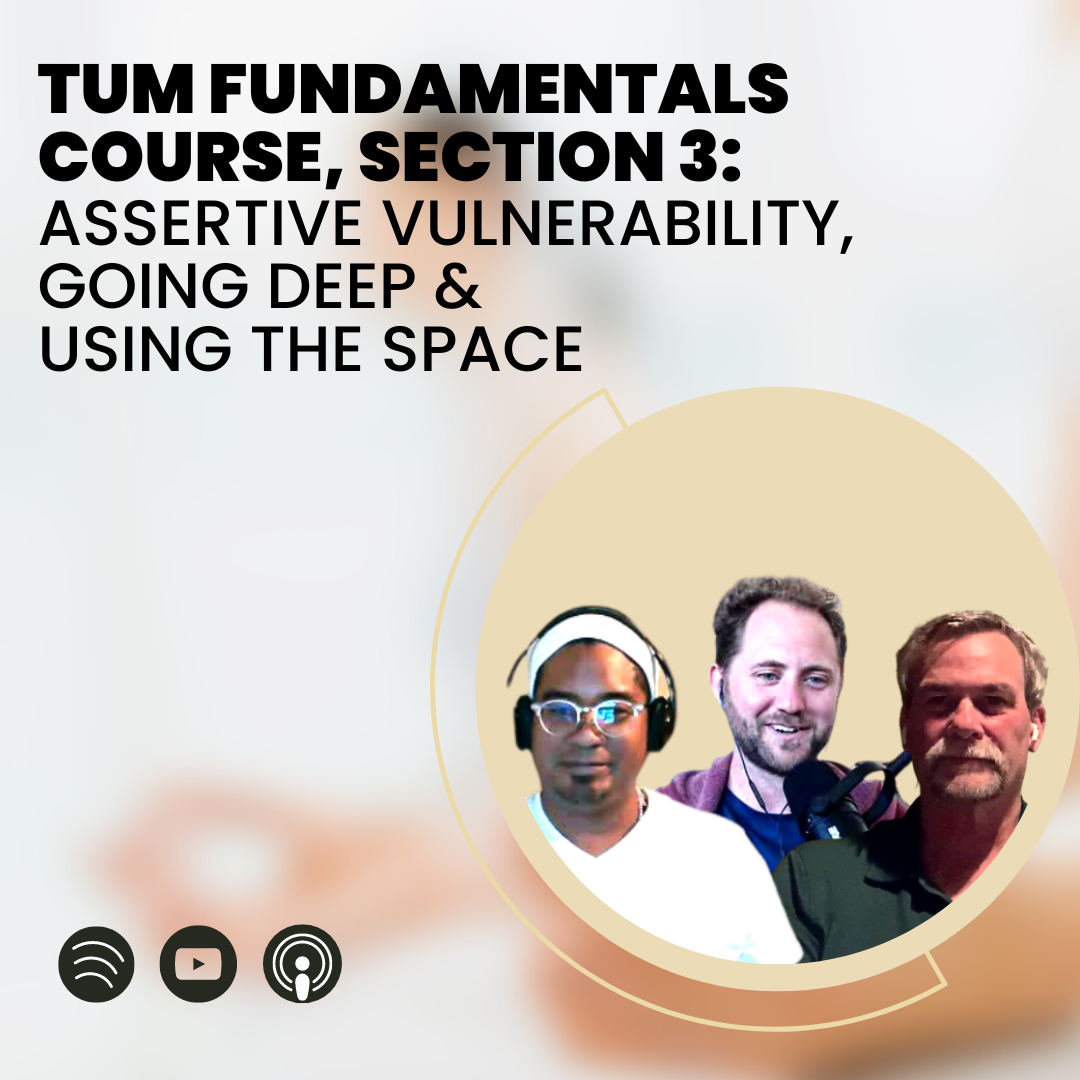
This episode is the third section of the Four (4) week Fundamentals Training: Section 3 – “Assertive Vulnerability, Going Deep & Using The Space”. I am once again joined by The Unshakable Man Community stewards, Londell Jackson, and Mike Messersmith. We are men who have volunteered our time to welcome new men into the Unshakable Man Community
This is a somatic journey that you’re moving through, as you move through this fundamentals training, you’re engaging with the Learning Center content, and you’re having a physical experience inside the group.
S2E11: TUM Fundamentals Course, Section 3 – Assertive Vulnerability, Going Deep & Using The Space
Show Notes:
- (04:37): What you can get when you join the group
- (07:48): How does the space change you?
- (20:36): Using the space to make a somatic journey
- (28:08): What do you learn from the training?
- (39:50): Going deeper in guiding all men in the group
- (41:17): What is rupture?
- (50:33): Practicing vulnerability: Deep reveal, if you knew me – flow, something that’s holding me back
Connect with Londell:
LinkedIn: https://www.linkedin.com/in/londelldjackson/
Connect with Mike:
LinkedIn: https://www.linkedin.com/in/michael-messersmith-8aa54814/
Transcript:
Introduction
Chris 00:00
Welcome to the unshakable man podcast and unity for men who want to practice tools and skills to get out of our heads, and to go at patterns and to get into our bodies. I’m Chris Wilson. I’m joined today here with Lawndale Jackson and Mike Mazur Smith gentlemen, I’ll let you give you an opportunity to say hello.
Londell 00:27
Hello, welcome.
Chris 00:32
It’s always that gap. It’s always that gap. It’s good to be with you, gentlemen, the here Lawndale and Mike, and myself, we are stewards of the unshakable man community. We are men who have volunteered our time to welcome new men into the unshakeable man community. If you’re listening for your very first time, today is the third section of our four week fundamentals training. And today’s theme is assertive vulnerability, using the space and going deep or choosing to go deep. If you are in the community, and you are practicing in your part of your in this third week, just like to review what we’ve been through, we’ve been through the first section of welcoming you into the community and getting started. And then the power of presence and how to check in we learned and go and then going to our very first unshakable man group. Then we went to our second group, and we talked about, we learned about survival, shame, the man box and belonging. And now today, we are learning about assertive vulnerability, using the space and going deep. This is a journey, this is a somatic journey that you’re moving through as you move through this fundamentals training. We are listening to these recordings, we’re engaging with the Learning Center content, but then we’re having a physical experience inside of a group. Early on, I talked about the view, the practice and the result. And so what I want to point out, is that you have actually been through something, right, you went to your very first group, and we learned about the power of presence, and how to check in, right, we learned that emotions are physical sensations happening in around the body, we learned that we can only do this work in the present. Okay, we’re always reinforcing the present. Okay, we’re getting out of the story in our head, and we’re coming into the body. And we learned how to check in. And in that first group, it was just our first time being there, okay, it was our we’re at choice. We’re not every man that participates in these spaces, you are always at choice. But we were learning how to check in for a very first time and then sharing just what in our life brought us here. And then we left that experience. Okay, we left the group went back into the flow of our default life. And we got to see how being a part of that experience shifted our relationship with the rest of our life, our experience of our life outside of the group, what I like to call our default life. And then if you’ve continued on in the fundamentals training, you listened to this net to the next one, about survival shame, the man box, and belonging. Okay, and we learned how to construct or discover what our relationship is with this man box’s culture of manhood. And then we went to a group, and we use that as a tool to find connection with the other men in the space, man who might look different than me, man who I might judge or perceive based on how they look or how they show up in the space to be different. And we used this one thing, this one cultural thing that we all exist within, to find a shared connection in our relationship with that box. Okay, by sharing what are what came up for us in that in a relationship with the man box. And again, as I share this, you’re at choice. Okay?
What you can get when you join the group?
All you really have to do with these groups is show up. You don’t actually have to do any of the things that we’re saying to do here to participate in the group, you can actually just be there and you will get something from it by simply witnessing and allowing yourself to be in the space. Okay. And so now Oh, we’ve reached this is the turning point. This is the the ARC of this journey, this somatic journey that we’re going on together. And when I say a somatic journey, I literally mean physically on or in our bodies, right? We’re having, we’re making a journey here together as human beings and men. And what’s very, what’s really special here. I think what I said before, Mike and Mondale was, this is the first time you get to go through a group for your third time, or something like that. But often call it Third time’s the charm. Okay? The reason one of the reasons why I’m conjuring or bringing back in what we’ve been through, is because a part of showing up in these spaces is simply becoming aware of the structure so that the structure, each time you move through the structure, each time you do a check in your body gets better and better at allowing, not allowing your your protective parts to relax in the structure becomes supportive. So that you can open more and more so you can participate in this space. Okay. And when it comes to this week’s theme, assertive vulnerability, coming to a group for your third time, this is really the very first time that you actually get to show up in this space. And you get to choose to be vulnerable. Right? You get to come in here with a real intent, a purpose, you get to move through the flow of your week, and something might happen. And you get to, you’re actually getting to say on your mind, and you’re, I have a space for this, I can bring this to the group. All right. And now the group is starting to become more and more purposeful, more and more useful in your life. And you’re learning how to be how to witness the other men in the space. Okay, which are part of the three roles we played in the group, which are guiding a man to go deeper, opening ourselves learning to open and to give a voice to places inside that maybe haven’t had one. And witnessing actually being honoring your body, and noticing what am I feeling? Where do I feel in my body? And what does that part need in the presence of another man? And so I would love to bring Lawndale and Mike into the conversation here
How does the space change you?
And I would love to start off with just a question gentleman about your own. And I’m surprising you guys with this one, because I didn’t want you to prep for this. And I just want to ask you guys about what it’s like to your own perception of your own maturation, and being in these groups, like, how has you? But from your own perspective? What has it been like? If you just describe your own experience, not of being through just your first three because you’ve been in way more than three groups? But how have you seen yourself shift or change and how you use the space? Or what it’s like to be in the space? If you can recall from the beginning to now.
Londell 08:47
Certainly, you and I asked to come up with some sort of order or giving this long pause. But in the meantime, I’ll I’ll speak right now. I, what comes up for me immediately is that there while I agree that there is a a somatic response that your body is learning how to respond and and it’s learning to communicate to your intellect, your mind. There’s also a piece that of our intellect, that we learn to let go of to certain degree because I go into places With my shields held high, my wall is, you know, 12 feet tall, and, you know, five feet thick, and I’m ready to protect myself from anything and everything. And particularly when it’s a room full of people, I don’t know, and and particularly when it’s roomful of white men that I don’t know. And I say that, particularly for a reason. And the more I went into community, the more I realized I did not need to have that wall. Now, my body, I could feel my body want to erect a wall? And intellectually, I’d have to say, No. And I would have to feel my body, relinquish that control or that desire to erect that wall. until it became the opposite reflex, where I would go into a group, and my body would feel comfortable and safe about not erecting a wall. And now my mind goes into a space of this isn’t a safe space, or is this a safe space. So now I’m into a space where I assume the best instead of assuming the worst. And this is now taking me outside of our community. We, which I think is, for me, a better way to live my life. Living my life in a space of love curiosity, and receptivity versus defense, anger, and vengefulness if I would even say that. And so for me, it so that is the what I’ve learned over time, is, I can go into a room, and my body now is less tight, is less fearful, is more open. And my intellect is now scanning for when do we need to begin to build a wall? When do we need to look for places to create safety instead of the opposite way?
Mike 12:52
Powerful, very powerful stuff. For me, I remember I remember going to my first few groups and, and, you know, being somewhat terrified, you know, to be in a group of men that I don’t know. Don’t know how they’re gonna react. You know, don’t know how I’m gonna react. Remember thinking about this somatic practice and feeling in like, What the hell is this? And, and this is bullshit. And, you know, I know what feelings are and, and all these other things. And I remember going through the check in and, and, you know, the first the first couple of times, not being, you know, not really being able to feel anything. And so, literally just just trying to come up with things to say.
Chris 14:02
Not being able to feel something Can you say more about?
Mike 14:06
Yeah, I? I had no, I couldn’t identify any feelings in my body. None. I was so shut down. I was I was so emotionally closed off to what a feeling was because all of my feelings came from here that, you know, even though they were coming from my body, you had no way to I had no way to realize that I had no, I had really no, I had no words. I had no, I had no healings for the feelings. Yeah, and that is that sounds. Just saying that sounds insane today. Yeah. But that really was That really was how I felt going into the first few groups. And now it’s, you know, Chris, you talked a little bit about, you know, the what is it you always have, you’re always that choice. And so I was in a group last night. And I just Chris talked about, you know, the three things witness being one of those things. And last night, I wasn’t the witness last night. Because I just, I just, I didn’t, I wasn’t feeling I wasn’t feeling drawn to, to share. But I was, I felt very drawn to, you know, the things that the men were feeling in the group and being with those things.
Chris 15:53
Was our experience of witnessing passive or were you active on an in your body while witnessing?
Mike 16:00
No, I was active Well, while witnessing active in my body?
Chris 16:05
Yeah. Can you tell? So, can you share what that is for you? Or what your relationship? Like? What is that? Yeah, sorry. It’s like.
Mike 16:13
Yeah, well, so when, when a man shares, you know, you, you actually, as you drop, drop in and slow down and drop in, to, to the container to the space. For me, it’s, it’s an opening. So when I drop in, I opened myself to the energy that’s going on in that space. And so when a man shares, you feel I yeah, I feel that share. I mean, when, when Lawndale talked about the wall, and when Lawndale talked about, you know, dropping that wall, and, and going in with an entirely different attitude, I felt that, you know, and I felt, I felt that I felt, you know, I felt that a warm sensation in my, in my chest, and I felt, I felt happy, I felt, you know, I felt I felt holding of Lawndale in that. So, yeah, so that’s, that’s, it’s an incredible, it’s an absolutely incredible experience, to go from that closed off person to, you know, to that open, you know, feeling personally.
Chris 17:45
So, we can talk about give more to this in terms of the nine components of emotional awareness inside in another session, but that for, to just use what we’ll talk about in the future and, and Thursday sessions, that emotional granularity, and that attunement, emotional attunement to your body. Right, connecting the head to the body. What I want to what I want to just point out from both you and lon Dell, is how and when we say using the space, right, when we say like, the first two times we’re coming into the space, and this could go on for more, right? Like this is a we’ve we’ve designed this with some structure, but every man has his own experience. Once you start coming in, and you’re there’s there’s a structure that your body and your mind, your nervous system can start to trust, right, these protective parts which are adaptive, and are there for a reason, right, they can start to trust the environment. What I notice, Mike is that when you’re witnessing in the space, you’re still even though you, you might be on mute, or you might be sitting back in your chair, or you might be holding your posture, you’re noticing when you relate to when you just share what your inner experiences and your own words what I’m connecting to is that you’re actually noticing the sensations on an in your body, in relationship to what a man brings into the space. And in my relationship with my partner, or with my little brother, the important people in my life, my dad, my mother, co workers, even you guys as friends, right? As fellow creators and this when we’re moving quickly when I’m moving quickly outside of the space. I don’t have this in my life right like with my partner when she shares her says something. There’s an emotional contagion there. There’s there’s an attachment of I can’t I can’t There’s so much about this relationship. Right? That I, it’s it’s very challenging to practice these skills on my own, like in the flow of the whirlwind of my life. But as soon as I hear what you share, Mike and Juan del mundo yours, I felt like you were going in and out of your experience of the group, and then talking about your experience in other containers and relating how you’re in my right, and was I following you there? Of how, okay.
Using the space to make a somatic journey
And so that’s the connection when I want to make for men who are in their third stage, right, you’re coming into your third group is that when we say using the space, we are going through this process, they’re making this somatic journey? In in, in wisdom practice, this is literally awakening, right? We are, we’re getting out of our head in the movie of our life and our thoughts and moods, judgments, stories, belief systems, and we’re actually opening to experience more or feeling more on in our body. And this is practice, this is training, right? Like we’re showing up. And to bring my own to answer my own question, like how have I noticed my self in this space, I took some notes, while you guys were sharing just were things you inspired in me. One was ruptures. Another was literally being able to seek sensation, realizing that sensations happening on and in my body, outside of the space are now they’re not always something to stamp down. It’s actually like, Wait, what am I feeling I’m feeling something, something’s happening here. And it’s, it’s, it’s actually allowing that to come up and out. And just while I’m driving in my car, right, like when I’m and and then I wrote sadness, exclamation point. And this is something that is, is very, this is very close to me. And, and also important for me to share in from a community perspective, is that my ability to be sad, a lot that my relationship with sadness is, is special. It’s, it’s, it’s now to a point where if, when I’m sad, at witnessing, and I just talked about this today, in another interview, and I was walking down the street this afternoon, and I watched this mother with a small baby, trying to struggle to get the baby into a car seat. And there was a young little boy that was still picking up a bowl, like under her waist height. And he was going nuts. He was like, just, he was absolute throwing a fit on the side of the road. And she I’m like moving quickly to my car to get to across town. I don’t travel very much anymore. So it was jarring to me to do this and across town. And I see her and she picked up her son in the most soft way. And said something like, baby, and just was so and he just immediately stopped and I was in I just noticed I cried. Like I just felt so it was so awesome. And to me, that is a sign of being open. Right? Like, like I noticed when that when that’s not happening anymore, right? Like I noticed on a Tuesday, in the rush of my life that like oh, I can’t feel that sadness, I can’t feel this quality this in it’s a sign that I’m not open. Um, I’m actually like, some protective part is there. And that used to be my life. Right? That used to be the experience of my life as it was I didn’t have think I was closed. It was just Earth. Right? And so, and this is this is over seven years, right? Like, we’ve been doing this work, right? But But this doesn’t, it’s not about the amount of time to me. It’s just and then why am I doing this? I wrote that down. I used to come into these groups at times and be like, why am I doing this? Like, I’m like, I don’t have a reason to be here right now. Right? Like, for me, this wasn’t about addiction. This wasn’t like at a certain point it became I don’t feel like anything is going wrong right now in my life, because initially coming into these groups, it was characterized by having to have something be wrong. And that that was a shame. For me, when I realized I actually come into these groups, and I realize how I feel like being in relationship and being surprised by the presence of Wandel, or the presence of Mike, even here in this, as we entered the space, I see how I am through you. Right. And it’s, and, really, it’s hard to compare about how advanced my meditation practice has to get how how, how intact, right, like my own seated practice to, for me to have that sense, alone in my bedroom or on my meditation pillow. Whereas when I’m when we’re in this group, once or twice a week, it I’m always I always leave energized. Right. And that, to me is the sign that I’m actually a Mac being just in relationship. And moving through the seven stages of a group, which we’ll talk about outside of the fundamentals training, we, it, um, you guys being in your presence, just witnessing you helps me let go of whatever emotional residue I’m carrying.
Mike 26:19
Crucify me, something you said there really, really resonated with me, because I remember, I remember coming, you know, to, to my first person groups. And, yeah, it was always about something being wrong, or something being missing. And then all of a sudden, there was like this epiphany, this moment. When I came to Abreu, and I, I didn’t have anything. And I just, I just, I just was in the group. And it was amazing how much I took away from that group. And to this day, I still remember that group, because it was just, it was, it was such a, you know, aha moment. And I was like, oh my god, I’m getting more from these guys. Then, you know, than anywhere else in my life. And I was just like, I just felt so blessed at that moment. So, you know, sometimes I come to group and it’s just a celebration. You know, I just want to share like. but yeah, some some sometimes you come to group and it’s just, uh, you know, it’s just, it’s just, you feel so good about something that you want to share. And sometimes you feel like shit, you want to share that. So it’s, you know, it’s, it’s just, it’s a beautiful thing.
What did you learn from the training?
Chris 28:08
So, assertive vulnerability. We’re talking about like, using the space. And there’s, there’s a challenge here that I want to bring in our saboteur story in the head of men who are getting into this work of, well, am i How is this not whining? Right? How is this not simply complaining about stuff that’s happening in my life? How is this not just a bunch of I mean, to be, to be honest, there’s, there’s something that was recently sent to me by three different men in our community of the crying CEO, right? Putting putting out a message on Instagram with myself crying, and then people are reacting to this and as like a narcissistic call for attention. So how I think it’s very important in our third week for us to talk about this, right? What, what do you guys want to bring in? How is it different?
Mike 29:16
Yeah, so, I mean, I’ve been thinking about…
Chris 29:20
going out of order.
Mike 29:24
We’re gonna switch off each time. Um, I’ve been thinking about this ever since, you know, the beginning when we were when we were talking about you know, talking about that, and I have never I haven’t experienced that in the container. And I don’t know. It’s it’s interesting to me. I mean, I literally I’ve been trying to think of, yeah, but I have not i i, i have not, and maybe it’s just because Um, you know, the facilitators that I’ve been with, have just been really good at identifying that and, and, you know, that says, Yeah, same same, hey, let’s, let’s slow down for a minute, let’s let’s take a breath into that let’s, you know, so So I think maybe that’s, that’s some of it is I haven’t really noticed that just because, you know, I’ve been in groups where, you know, words, it’s just been quickly identified. And, and, and I don’t want to say dealt with because that’s not that’s not the right word. But, you know, showing, showing the practices. So that, you know, so that we get to the scene, we get to the root of what’s going on.
Londell 30:53
It’s good that we were talking about this today after having spoken or discussed the man box, because I think a lot of this comes from the idea of why of men being vulnerable about situations in their life and expressing feelings about situations in their life and then being told that they’re whining, or they’re being narcissistic, or they’re attention seeking. In my mind, this is this, this couldn’t be a more perfect example of putting someone in an or an ideal that is within the man box, as, as defined by United States standards.
Chris 31:42
Great reference.
Londell 31:45
So for me, whining is bitching about something, just because you want to bitch about it, and then not coming up with any sort of constructive way to deal with the issue? or blaming someone being down on yourself about something, again, and not? And just complaining to complain? Quite honestly. I know, I’ve done that a lot of my life, and it’s just like, Oh, what was me? And yes, we all have that ability. And, and we have the permission to to go into that space. So I’m not going to go and say that we can never have that. But the piece is, is that one, we want to stay there and when we’re not open to understanding, where is this coming from? And how can I move past this? How can I move through this? How can I move around this? Yeah, yeah, that’s the difference.
Chris 32:57
Or even it is moment, bringing him to be with it. And allowing as a task right, like in the container.
Londell 33:05
Yeah. And so and whining, I’m pretty certain that we typically well I guess there’s been times when I’ve labeled my my my actions as as whining because I’m again reflecting and leaving labeling myself from the American man box Stan a standards but more often than not, this has come this is a an extrinsic labeling and an extrinsic process that someone else is trying to, to put on to someone else. And we can either choose to own that or not. And so so now we’re dealing with two issues. 1am I going to own this title of being whining or am I an narcissistic? I mean, being a narcissist is actual psychological disorder and so I’m not going to argue with licensed practicing psychiatrists psychologists and other mental health practitioners yet we are not if we’re not no and but not an to have an a situation and someone from the outside labeling me as a narcissist, because I go onto my social platforms and express my emotion and what have you and then someone else labels me as a narcissist. That is not my issue. That’s someone else’s issue about how they view view, my actions, my outward expressing of my vulnerability. And so now they have to deal with so we said that We’re seeing this earlier, they’re vomiting all of their shit all over me, and trying to make me own it. And I can choose to not own it. And, and then, or I can choose to own it.
Chris 35:13
What I think you’re making a case for, and is what happens outside of a place with a container. Right that this is this is what can happen right in the blogosphere, the Instagram, in your kitchen with your partner with a group of friends. While at the DMV, right, like waiting in line for something. But what is key for me, what I hear in here is that in this space, when we say my name is I am Chris, and I am checking in the somatic and psychosomatic frame that is created right like I am Chris and I am checking in. And then I pause, and I go into my perceptual database, and I choose to start to express or say something. And the men in the space are holding that space. And then I have some experience, right? Something is happening, right. And what we’re painting a picture of is that that is a thing, right? Like the bat that you guys. Well, I may have a sensation in my body, and then it triggers a judgment, but I’m able to recognize or at least the container. The key is that is we’re able to recognize our judgments. Right. And maybe just maybe Lyondell if I’m and this is what I think I want to point out from Mike too, is like, he’s like, Oh, I haven’t experienced this because guys stop it is that when we’re in the space, if I’m spinning out in my life, and this has happened, I have had this happen. I’ve had groups where I personally have shown up and then moving through something multiple times over a week period or two week periods. And the men in the space say to me, Hey, when you said that, Chris, I feel tight. I feel gross. Like this doesn’t feel right, like I write and, and then maybe something like the story in my head is that this just doesn’t feel like I Right. And their bodies are sending them a message that may be right. And it’s I think the key here is that distance, right? That that boundary that allows men to use the space and for me to for you maybe Lawndale to express and share the story or the judgment that you’re having. And for me to remain open enough to receive it. Right and to actually write myself right to actually own that, hey, I’m, I’m really caught in something over here. And and I think what I you know, we can get into this again, in later talks on our Thursday stuff. Or we can bring in other people to talk about this, like Dr. Chris Bromberg has talked about this quite a bit, where this is what we don’t have in our life, right as human beings, like, we’re all super connected and not connected at all right? Like the tribe held us together. And that it’s not there. It helped us really find out from spinning out and I will say there’s one really cool show you can watch alone on the History Channel. Have you guys seen alone yet? Okay. Case in point, we’ll put this in the recording that and, and digging deeper resources and the learning center but alone. Season One, season two, I think there’s like 10 seasons, a few men in our community have mentioned it to me and I went and started watching it, you’re alone in the woods, for a period of time dropped off with 10 items all alone with a video camera. And you can see what happens, how we are not meant to be alone. Right? Like as human beings we we like being out in the wilderness without needing to survive to get rescued is very different than being truly alone and staying there. Right. And we are all deeply alone in our experience. And what’s happening in this group in these groups when we check in and we learn to use the space is I get to read how is what I’m bringing into the space how is it coming off? How is Mike receiving it? How is Lawndale receiving it? How are eight other men receiving it?
Going deeper in guiding all men in the group – is a benefit
And so And the final thing I want to share in this is that because as our community grows, this has come up from a bunch of different men have said this in different ways. While the group is getting bigger, if I don’t share, right, if I’m not sharing, how do I, how am I getting anything from this, right? And at least in the community groups, right, because we can have individual private groups where there’s just five or 10, men moving through a process are showing up the same time every week with each other. But in our community groups, I think one of the biggest values we get out of being in this program is getting to see if there’s 10 or 20 men in a group for an hour, and two men go really deep. Getting to witness that and getting to witness another man guide that man deeper is, is a is a benefit. To me, in my experience. From witness,
Londell 40:53
The piece about creating a brave space versus a safe space is, is essential to the this whole process. Because in in the brave space, we’re able to challenge each other in a respectful, loving and caring way, versus a safe space where I don’t believe that.
What is rupture?
Chris 41:17
The other note I took was ruptures. That’s the other area that I think it to this theme of using the space ruptures have been a huge learning experience. Because when there’s a rupture in the group, maybe which can happen, right, like a man can bring something into the space. And especially, I think this is this is one of the number one things that I am is currently an edge for me. And then the steward ship of this community is as new men come into the space, disruptive behavior, right, we have agreements to in order to be able to do this work. And when there’s a rupture, we’ve, we’ve been through this over the past two years as a community that it’s very important to come back to this, this core intention that we are all here to practice tools and skills to get out of our head and into our body. It’s not necessarily to be friends. Right? It’s not necessarily to be to feel a sense of brotherhood. Right? It’s not necessarily to, right. And when it when that is challenged, I think that’s when we have the most beautiful learning experiences of being able to be in in a difficult hold that container in a in a fierce, open hearted way, and actually stay on that line, right of this is what I’m feeling in my body. This is what it needs, and then learning to give it to it, give it for myself and maybe having the support of other men in the space to assist, right. But thankfully, we have not had any violent or, or attack attacks on men in the space where energy and awareness has been directed at another man. But I do want to say, while we’re here, that that would be against our guidelines. And that would be that would mean that you are not taking responsibility for what is happening in your experience. You’re putting it on to or directing it to another man, which would mean that we can’t do this work. The group would. That is not that is another very different thing than using the space. Awesome. So third week, assertive vulnerability, using the space and going deep. So the stretch for men this week coming into the space is to use the space and to learn how to do that. We’ve picked our top three prompts, you do not have to use a prompt. In fact, I would prefer you don’t. If you if I would prefer you just come in and learn to work with whatever is present for you. And so the there’s two topics here that we will reference and we’ll talk about these over and over again. One is scanning your perceptual database, I say it over and over again. When you come into the space, and it’s you have an opportunity to open and you choose to use it which is one of the roles. It’s in the second round check in so a man the floor is open and we were out of office Scylla tater are men in the space of say, Okay, who would like to go? You, when you say I would like to go and my name is Chris and I’m checking in or My name is blank and I’m checking in, the next thing you do is you have this opportunity to scan and to choose something from the whirlwind of your life, how deep? How far do you want to go? Is it something that’s stuck in the, in a recent past something that happened in your life, something that’s deeply rooted, right, and that is a skill, to be able to scan, and to just pick that thing. And then when you pick it, there’s something that happens, and this is we’ll talk about this again, also in the future, which is, there’s a context and then attach that context, there’s a narrative. And then that context and that narrative, create a story. So there’s like this thought object, there’s some relationship to that there’s a context. And then there’s this narrative. And you’ll start wanting to learn, you’re going to come in, and you’re going to need to learn how to tell it, how to bring men into that space. And this is where I always like to say that we’re not really having conversations. Right, like Londo, and I might talk after a group and have a beautiful conversation about something that came up from that group. But when you’re sharing, what we’re actually doing, is conjuring we’re bringing something out of our experience, we’re scanning our perceptual database. And I’m hoping this isn’t too advanced, I hope this comes across Vondel. And Mike, tell me if I’m, if this is not gonna translate over in a class like this, you’re grabbing something, and then you start to tell it, talk about it, start to stare it. And if you start to go off into a story, the men in the space may may adjust you and say, Hey, what, what’s the context? What’s, what’s important here? What feels resonant? Right? So you can get to it. And then we help you come into the experience by asking you three of our most important questions, what are you feeling? Where do you feel it in your body, and that’s where we’ll, we’ll save that for other sessions. Okay, we’re, we’re getting out of the story in our head, or getting into our body. Okay. And that’s where we get into dropping out of story. So the, one of the one of the easiest ways are the most resonant ways to notice this is I think we say it a lot here over the past three sessions, where, when Mike or when Londo when you guys have said something, and I share it to you, when you said that, I felt something. And then there is a relationship with that, we’ll use the sentence completion. And the story in my head about that is bla bla bla bla bla. What this does is this allows me to take responsibility for what is my story in my head. And I’m practicing the skill of taking responsibility for that, while sharing it with another man. And this gives that man who hears it, it should it allows his protective parts to stay relaxed, because I’m not saying, hey, when you did that, you’re doing this. Right? And maybe that will help him to see himself through your story. Or maybe your story is just about your experience. Right? And this is what develops relational intimacy. This is a very, it’s simple, yet profound way to start to develop a sense of relational intimacy. Because the men in the space don’t know. I don’t know what stories are in Mondale’s head. So for for Lawndale for you to pause, and to tell me what’s happening on in in your body. And then to share the story in your head about it is a gift. It’s an it’s a huge gift. Right at your voice and your tone. And your whole experience. The human voice conveys so much more than I mean, it’s everything right? Did you guys want to jump in there on anything I know that went off, we don’t have to, but if there’s anything that you feel inspired to share. Okay, cool. So we’ll we can end here tonight on the juicy part, the juicy part. And so there’s three prompts. And we’ll we’ll we can each pick one, again, you gentlemen are at choice, we don’t have to do this because this is a recording. But the three prompts that we can, if you’re, if you’re listening to this, and it’s your third group, and you really, you feel you don’t have to make up your mind. And please don’t practice, please do not practice before coming to a group just show up, okay?
Practicing vulnerability: Deep reveal, if you knew me – flow, something that’s holding me back
But there’s three prompts you can use, if you’re looking for some creative tools to help you. Okay, these three prompts, one of them is a deep reveal. The other is an if you really knew me, flow. And then the third one is something that’s holding me back. Okay, so I’m just gonna explain briefly each one. And then Lyondell Mike myself will will pick straws or something. And so this is fun. There, we got to do this before. So on a recording, so a deep reveal. So what a deep reveal is, is its power, its power is held in your choice, your your choice to, to pick something, one thing, and to presents it to bring it out from a place inside, and to bring it into the space. And something that is I think important about a deep reveal is that it is just one thing. And that when you check in and you say my name is blank, and I’m checking in, you pause, and you come into your experience come into your body. And when you share your deep reveal. You allow yourself to come back into your experience and to allow silence to come back into the space. And will often invite a soup breath, which is a breath where you inhale in your nose like you’re smelling, you just walked in the house, and you noticed some beautiful smell, right? We all know how we automatically do it, we just and what’s important about a suit breath is that it’s not it, softness allows us to feel more. Whereas a deep breath like actually has an intensity that can cut off sensation on an in the body. Okay. And so the deeper view, when it’s put into the space, you’re also there’s what’s happening on and in your body. But there’s also the sensations that are happening on and in the body of the men who receive it. And so we invite them, the men in the space to inhale. And exhale, to be with what is happening on and in their body. And then after about 10 to 20 seconds there’ll be there’ll be something to relate to, okay. And we’re not going to get into the any process here or go deeper into it. And I do just want to set the container. We talked about this before, that we’re going to do these as an example. But this is an example we’re not actually in a group. And we’re doing our best to not act to create some structure here to give you guys some insight, but I want to just notice that we might cut at the end and just shake it off, just to create some space. And then we can talk about what it was like. The second one is if you really knew me, something that’s really powerful about if you really knew me is when you say your name you’re checking in, if you really knew me, you do five or 10 If you really knew me, and there’s this latter approach to other than if you really knew me, and some free association. And so what happens is as if it can be it we often can get up in our head about how to say things correctly. And so the rhythm of if you really knew me, you would know blank. If you really knew me, you would know blank. If you really knew me, you would know blank. That’s fast actually, for me, and as I reenact it here it actually for me is usually something more like if you really knew me, you would know, if you really knew me, you would know, if you really knew me, you would know, And notice how whatever comes out that there’s this soft inhale in the nose, and then an exhale through the mouth. And to be with the sensation on in the body, after what is shared, okay? Because what what we’re doing here is we’re, we’re literally learning to be with a man in his experience without, without needing to fix or to change. And the gift of receiving a man share is I don’t know what you’re gonna share, say. So when it goes out into the ether, I, you’re helping me find like, wow, like, something will come up on and in my body. And so it’s very important to do that soup breath. It’s just the softest like. Okay. And then the third one, which is probably like the most utilitarian, I’d like this one, I really enjoy this one. In groups. It’s, it’s, it’s really neat to see how this one helps with the, with the, the masculine. Bringing the masculine into the penetrative masculine, desire or need to penetrate into our life to, to, to, to have direction, right to have to make a choice to move towards something, right? The call to adventure. And this one is something that’s holding me back is okay, because a big part of this work is actually bringing this work out into our life. Right. And we haven’t talked about our inspired integrations yet. But we’re going to do that next week, that we’re not just keeping what’s in the space in the space, we actually take this work, what happens in here, and then we do things outside of the space that are related to being in here. And so that this one is more direct. Something that is holding me back in my life is here you go. Okay. All right, gentlemen, we’re feeling are we feeling energized and connected enough to take a safe risk of vulnerability on a recording?
Londell 57:48
Why not?
Chris 57:50
All right. Should we rock paper scissors for who gets first pick? I think it’s all right. So yeah. I’ll take the first pick. And if you really knew me, or something that’s holding me back.
Londell 58:17
We’ll go with a deep reveal.
Chris 58:19
Okay, so to just create a container, just like we’re in a group, my name is blank. I’m checking in deep breath, Mike, just to prepare us. Let’s just take a few deep breaths in our nose. And I do just want to set the container we’re not going to we’re not going to bring you through any process or anything like that. I’ll give you the opportunity to close out your share.
Londell 58:45
Okay, and what’s the prompt again?
Chris 58:52
After you check in my deep reveal is, Oh and don’t forget to say I’m LONDELL, I’m checking in.
Londell 59:23
I’m Londell and checking in. My deep reveal is I oftentimes feel as if I am an impostor. This is Londell and I’m checking in.
Chris 59:47
Thank you, Londell, Mike, what did you notice? I’m happy to go.
Mike 1:00:05
Total connection
Chris 1:00:12
Londell I noticed a an insecurity I noticed a tension on in the front of my body right as you’re getting started when you’re paused and I took a inhale my nose and softened and there was there was an like a depth for me of waiting to hear what you would bring into the space and then when you when you shared what you shared I noticed like a judgment of and like a relief of like who as you’re going to share something that right and then I felt bad about that. All right shall I go or should you go like you go you pick you pick leave me last leave me last I made this up so I’ll go.
Mike 1:01:28
I think I go with “WHAT HOLDING ME BACK”, I’m Mike, and I’m checking in what’s holding me back in my life is a need to always be right not going to checking in.
Chris 1:02:03
Thank you did you guys notice anything trying to just stay in my tender space this is really cool.
Mike 1:02:40
To really (inaudible) it’s I don’t know, maybe because it’s recorded. Maybe nickel. You know, we know that other people are going to, you know, are going to experience in or you know, be with this. It’s just it’s just really it’s just really cool.
Chris 1:03:22
Yeah. Yeah, I you know, while we wait for Landau something I keep noticing as we move through the process of creating these is this like, outside of this space? There’s a when you said like needing to do it right or needing to be right. For me, it’s like, there’s like a quality like attention, right and insecurity. Hey, into the imposter, right? How do I do? What’s this gonna be like? Right? And it’s all these questions are up in the head. And then there’s like this dropping in to Okay, we’re gonna do this, we’re just gonna see what comes out of it. And then being in here with you gentlemen, over the experience of this, I feel how this is a this is love like this is created. This is how we are taking our experience and and doing in, in the only way we know how just interacting with one another. You know, it’s this it’s just beautiful, man. It’s just really beautiful.
Mike 1:04:41
Well,I mean, it’s something else that you know, you mentioned the love and it’s so compelling how You just feel that love, you know, and you feel you feel love for. I mean, you know, you and I have never met in person, one Bell, I’ve never met one down in person. But, you know, I’ve never met, I’ve only I’ve only met one person in any of the groups that I’ve been in once I’ve met one person, but there is that there is a level of, you know, there’s a level of love that that transpires. And, you know, a lot of, you know, for me, my experience has been because of the man box, right? That love is something that’s only, you know, only shared with, you know, those that you’re really close with. And in this container, you know, there is that level of, of closeness. And it’s, it’s amazing how rapidly it happens.
Chris 1:06:18
It’s, well, Londell got kicked off, he’s on his way back. But it’s, it’s neat to be able to be here to it’s such as meat, it’s just to the, to an expression, right of what we are doing in group. It’s really, it’s just, it’s like, it’s like nonverbal. It’s very hard to verbalize what I feel and see when it’s like we’re having this. We have this experience as a group of human beings as a group of men. We’re learning to structure the group. And now it’s like, okay, we’ve been doing that for two years together. And now it’s like, how do we structure it outside to bring it into our life? Hey, Londo. Welcome. Welcome back, man. Thanks. So sorry, we lost you.
Londell 1:07:18
I didn’t know I was gone until I heard you say that you’re waiting for me?
Chris 1:07:23
Oh, no, no. Well, while we were waiting, we had, we got on a beautiful tangent of, of just appreciating what it feels like to be in this space creating this. And I, I’m happy that we get to record this for the men who are going to engage in this, because I think it it expresses, it’s hard for me to give words to what it feels like to create this. But to be in this space with you, gentlemen, who we’ve been practicing together for the past two years. It’s really neat to feel the quality outside of this of how I can get into my head. Or I can have fear or insecurity and Mondale to what you shared. I actually realized imposter syndrome syndrome like that feeling of being an imposter for me outside. But then when I come into this space with you, it’s like we have this skills, the skills to be with each other and that fades. And then this experience is like love, it’s creativity. It’s just this expression and this back and forth. And then to layer on top of that, that we’re doing this to literally share this with other men, with other human beings to welcome them through this journey. It’s like it’s just boss. Agreed. As usual, one powerful word from Lund Del Sol we need all right. I’m Chris. And I’m checking in if you really knew me, you would know that I grew up in a bed and breakfast on Cape Cod, and got to watch my dad. I got to be in his space and watch him work that’s really affected me more and more. Feeling very thankful for that. If you really knew me, you would know that I when I was in high school, I wanted to try to make the US National Team and cycling and Really what I was doing is I I felt like afraid to sit still, there was like enough a fear of being still like if I was still and I was just being I’d be worthless, if you really knew me you would know, after the year after my anxiety attack when I was 28 I noticed my throat getting tight I sat on the beach and looked out at the ocean and had this this incredible fear of I could see the Golden Gate Bridge and I see it now of like I could feel how what it felt like to to now want to live and fell so deeply alone and at that moment I also felt more alive and more connected to anything I’ve ever felt my whole life I’m Chris and I’m checking in.
Londell 1:11:50
Thank you Chris
Chris 1:12:11
To be honest I feel that that was a lot for me right now to be in here to go from where we just were to what I’m feeling I’m feeling tension in my body and the need to like just take some space for myself.
Mike 1:12:43
Feeling deep connection and share about your father I just felt they felt a warm sensation you know throughout my body I felt just felt love and what you shared about the feeling of being still and that being a feeling of worthlessness. I resonate with them to this day and I just you talking it’s like we talked about earlier in this episode I just you know the feelings that I had based on your share were extremely impactful.
Chris 1:14:10
Thanks Mike. I do want to just check in with you guys and let you know that like I noticed as I did that I there was like a I felt locked up after and there was like a thing of like doing this on a recording for me and I felt like frozen after which is not which I judged and didn’t like but none I noticed Mike as you as I was able to check out and get out of my head and get down into my body like you’re even mentioning my dad is able to feel softer and like tears come up and this is this is a No, I just I really just feel the need to, like speak to whoever might listen to this, that this is not a. This is like very important to me. And, and also not a, like, this is a, this is our group right now to me. And important felt tight, it’s um, I care about this, what happens in this space right now. And I hope we close that out with the way that we would close out a group. And it feels very special to share this on a recording.
Londell 1:15:40
Yeah, I wanted to quickly say that I really felt a profound connection. When you Chris mentioned about sitting and seeing the Golden Gate Bridge and feeling. And I’m not going to say your words. Because I can’t remember them verbatim now about not wanting to be here that is a feeling that I’ve never I would never wish on anyone. And I know. And I’m sorry that that’s something that we have in common.,thank you for being vulnerable and sharing that that is a space that’s a dark space. It’s a learning space. It can be a learning space, I should say. But it’s a painful place. So thank you for taking us there.
Chris 1:17:26
I’m feeling bashful. And and also, I’m here. This is this is what we’re doing. And this is that’s what yeah, thank you. Thank you so much, Linda. I feel a desire to close this out. And, and to bring back the men into the space who are listening. And to thank Mike. And thank you Mandel for showing up and to the men who are moving through this program to honor you for getting this far. And I’d like to just bring in and to bring us back to the stretch for this week. After you listen to this episode, your stretches to simply attend your third group. And to bring us back to assertive vulnerability using the space and going deep. And I just want to end on one final reminder that you are at choice. The what we shared in the space here tonight is just an example that we use here. From a place of creativity, and for me if speaking for myself from my heart, from a desire to simply share this work with more men. My hope is that that hope this is our way. This is what we’re doing. sharing this with more men. Thank you so much for being here. We will see you in group Good night.